On Saturday night, at 99 Wooster Street, you walked into a former firehouse and left approximately two dollars at the door.
You did not receive an annual report.
You received music, a crowded floor and a few hours in which your body no longer needed permission from a world that considered it suspicious.
On Monday, the money paid for the telephone, paper, headquarters, lawyers, lobbying, meetings and direct actions of the Gay Activists Alliance.
The revolution had a cashier.
The cashier had a strobe light.
This is the story of a political institution that understood something many nonprofits would discover much later, after enough workshops accompanied by tragic biscuits: people do not fund ideas alone. They fund places where ideas make them feel alive.
In the early 1970s, the Firehouse was not a metaphor. It was headquarters, club, cinema, meeting hall, social infrastructure and a machine for generating activist money. The National Park Service describes it as a place where the organisation became “a school for democracy.” City archives state more plainly what the school did on Saturday:
Dancing.
As many as 1,500 people.
Politics, but with a bass line good enough not to feel like punishment.
1969: after the riot comes administration
Polished histories often jump directly from Stonewall to Pride, as if the brick thrown in June 1969 instantly produced a rainbow with sponsors, a stage and compostable toilets.
Reality was less graphic and far more exhausting.
After the riot, someone had to build an organisation.
The Gay Activists Alliance, or GAA, formed in December 1969 after breaking away from the Gay Liberation Front. Its members wanted a structure explicitly focused on gay and lesbian rights, with rules, committees, elections and legislative goals. The New York Public Library holds 21 linear feet of GAA records from 1969 to 1983: minutes, correspondence, flyers, photographs and legislative files.
Twenty-one feet of paper.
That is how long liberation bureaucracy can become when the archive owns a tape measure.
GAA adopted the Greek letter lambda as its symbol and built an internal structure that was almost provocatively democratic. There were committees for political action, civil rights, public relations, finance and social activities. Members learned to write press releases, run meetings, negotiate, vote and turn indignation into strategy.
Very little sex appeal in the minutes.
Extremely sexy in the effect.
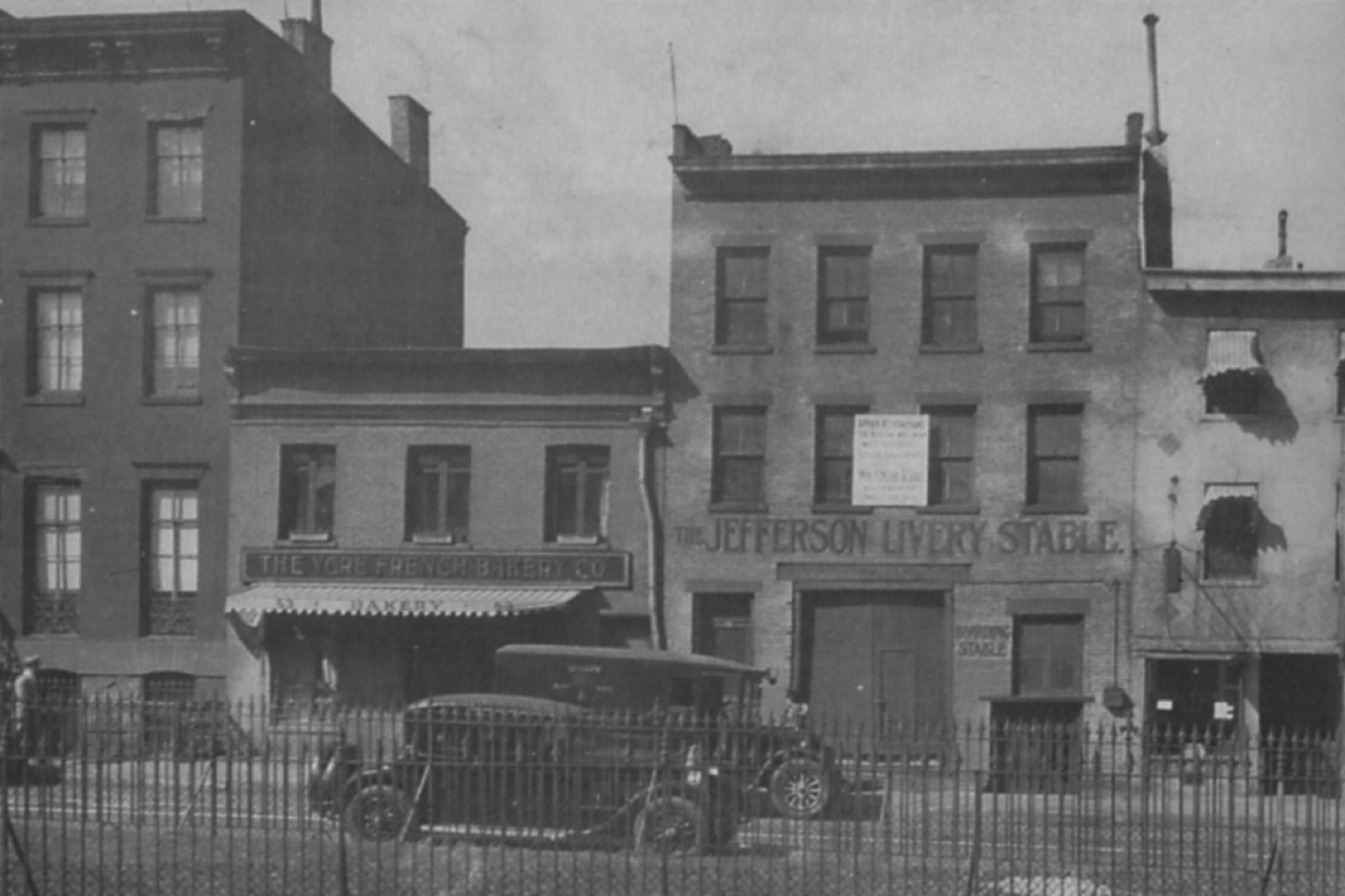
51–53 Christopher Street in 1928, before the Stonewall Inn. Photograph: Percy Loomis Sperr / New York Public Library, public domain, via Wikimedia Commons. A riot creates the moment; institutions must then build its muscle memory.
May 1, 1971: a firehouse becomes a political apparatus
On May 1, 1971, GAA opened the Firehouse, a former fire station at 99 Wooster Street in SoHo. The organisation had leased it and turned it into headquarters. According to the NYC LGBT Historic Sites Project, it remained the centre of GAA life from May 1971 until October 1974.
The opening date was not chosen shyly.
May Day.
Labour’s holiday, ideal for an organisation that had just invented a form of political labour paid, in part, by people dancing.
The original flyer is a gem of insurgent design: hand-drawn flowers, stylised couples, 9:00 P.M., the address, and the word DANCE large enough to be seen by anyone still pretending to have come only for the politics.
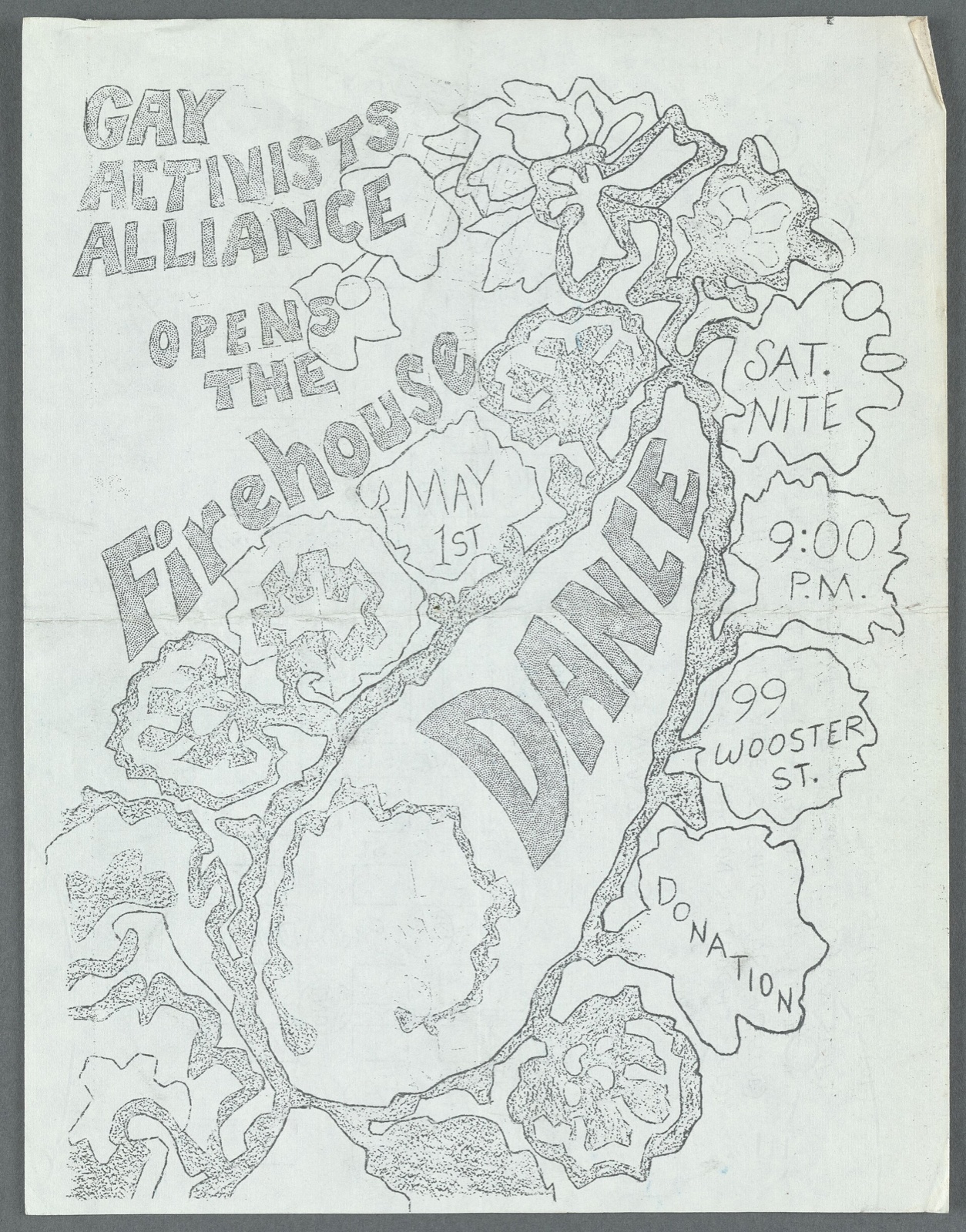
Gay Activists Alliance opens the Firehouse Dance, May 1, 1971. Creator: GAA; New York Public Library collection; CC0 via Wikimedia Commons. The document says “donations” without embarrassment. The party already understood its business model.
The building was more than industrial décor, long before industrial décor became a premium subscription.
General meetings and committee sessions took place there. Zaps were planned there—fast, theatrical and inconveniently public direct actions designed to make politicians, institutions and the press unable to ignore discrimination. Films were screened there, including Friday programmes curated by a young Vito Russo, who would become the essential historian of queer representation in cinema and author of The Celluloid Closet.
Friday, film.
Saturday, dancing.
Sunday, presumably someone searched for the minutes underneath a glass.
How much did the revolution take in on one night?
The LaGuardia and Wagner Archives say the weekly dances drew an average of about 1,000 people. Other historical sources, including the NPS and NYC LGBT Historic Sites, cite nights with as many as 1,500.
In the PBS documentary series Disco: Soundtrack of a Revolution, an oral recollection of the Firehouse puts admission at around two dollars. We do not have a full ledger for every Saturday, and turning oral memory into a Deloitte audit would be both reckless and vulgar.
But we can perform illustrative arithmetic:
1,000 people × $2 = $2,000 gross.
1,500 × $2 = $3,000.
In 1971 money, that was substantial. Not all of it was profit: there was rent, sound, maintenance, security, drink, cleaning and a building which, being a former fire station, probably possessed the thermal charm of an administrative punishment. But the dances became the organisation’s main source of revenue.
That changes the meaning of the floor.
It was not only where a community rehearsed freedom.
It was where freedom paid its bill.
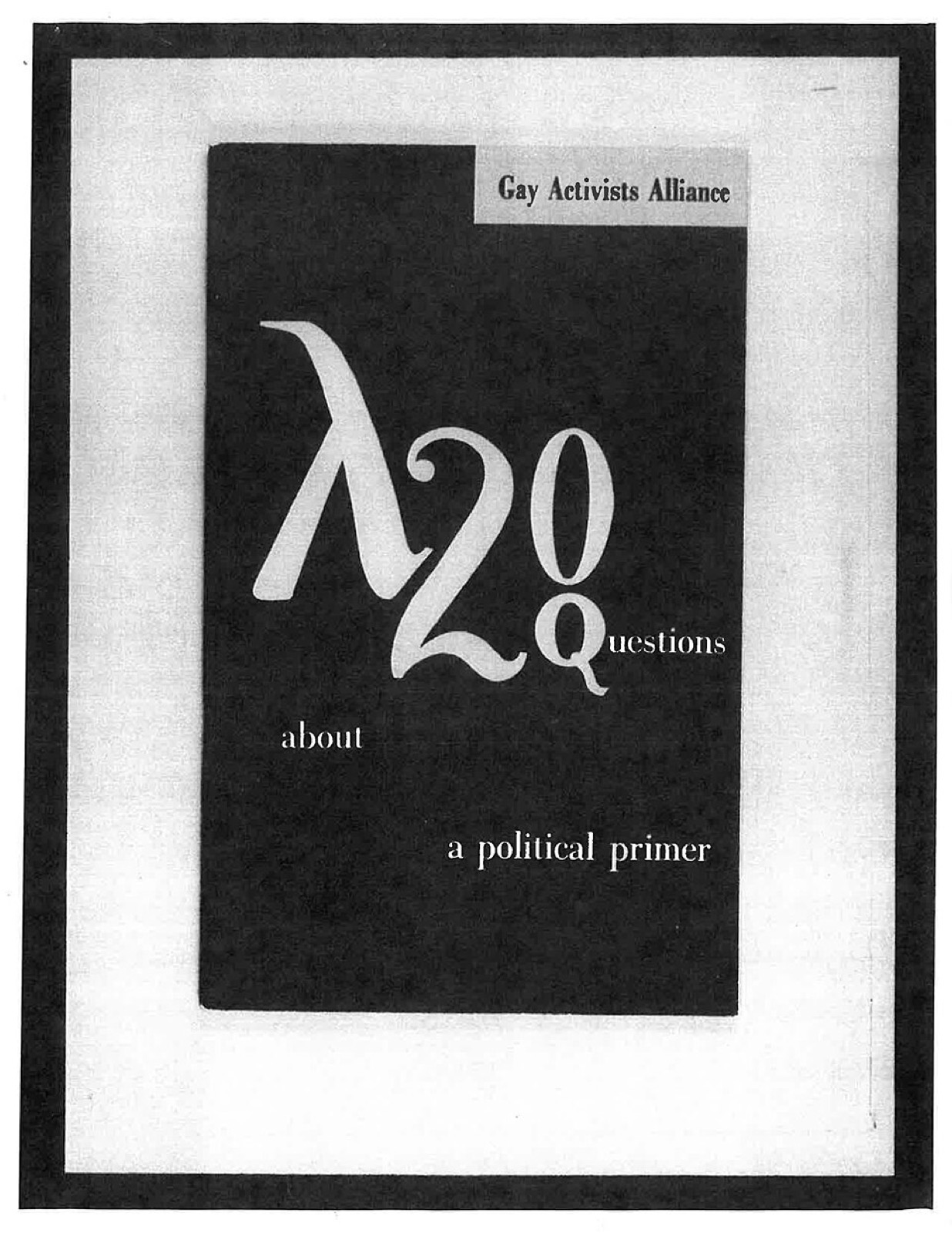
Gay Activists Alliance, “A Political Primer.” LaGuardia and Wagner Archives, CC BY-SA 2.0, via Wikimedia Commons. The revolution had a manifesto, a logo and—because it wanted to win—answers the public could understand.
What the two-dollar ticket bought
GAA pursued specific goals: protection against discrimination in employment and housing, repeal of sodomy and solicitation laws, an end to police harassment and entrapment, access to public space and political recognition.
These were not slogans left to age gracefully on a tote bag.
They were files, meetings and confrontations.
In 1971, a bill protecting gay rights entered the New York City Council. Years of delay, hearings and opposition followed. The city’s law prohibiting discrimination based on sexual orientation would not pass until 1986.
Fifteen years.
Long enough for a slogan to become an institution, one activist to tire, another to take over, and an entire generation to learn that history does not autoplay.
The Firehouse provided the infrastructure between protest and result: money, address, telephone, people, discipline and somewhere to return after authority politely told you to disappear.
In publications such as “A Political Primer,” GAA answered basic questions about homosexuality. In committees, it prepared policy. In the street, it applied pressure. On the floor, it produced resources and belonging.
This is the circuit pop history often forgets:
pleasure → money → organisation → pressure → change.
The poster prefers its revolution with a raised fist.
Accounting does ruin the lighting slightly.
October 3, 1971: from the last dance to the morning’s first zap
The most elegant demonstration of the circuit came on the night of October 2–3, 1971.
After the dance ended, at around 1:00 a.m., participants left the Firehouse and headed for the residence of Saul Sharison, chair of the City Council’s General Welfare Committee. Sharison was one of the men blocking the gay-rights bill.
The NYC LGBT Historic Sites Project records that as many as 1,000 people may have joined the march; the New York Times estimate was roughly 500.
The difference between 500 and 1,000 matters greatly to statistics.
To a politician awakened after one in the morning by several hundred homosexuals who had just left a dance floor, it was probably a more philosophical distinction.
The crowd walked up Broadway and staged a zap outside his home. The dancer became a demonstrator without changing the interior architecture of the body: same energy, different destination.
The party did not “support” activism like a discreet logo on a backdrop.
The party became activism through the door.
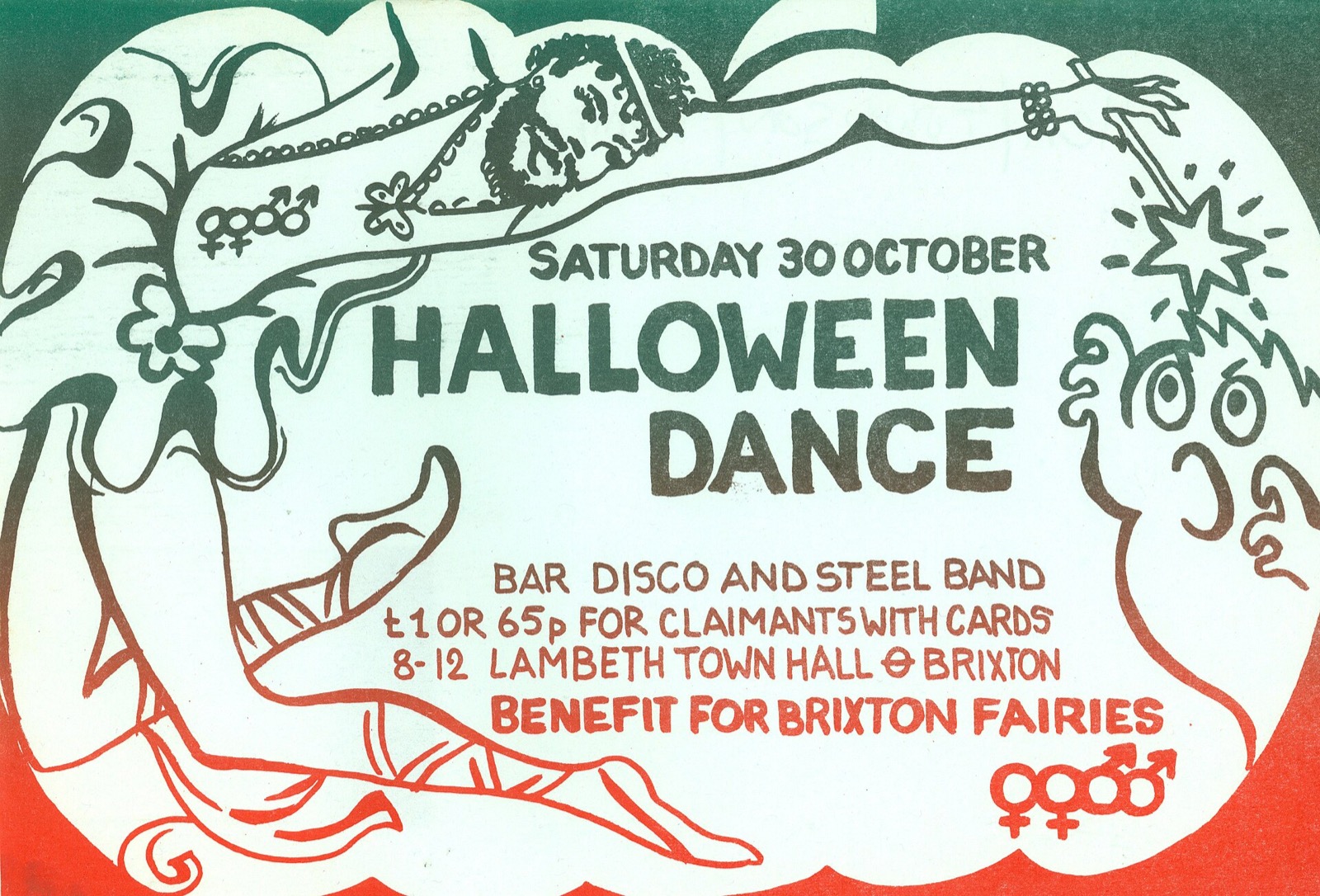
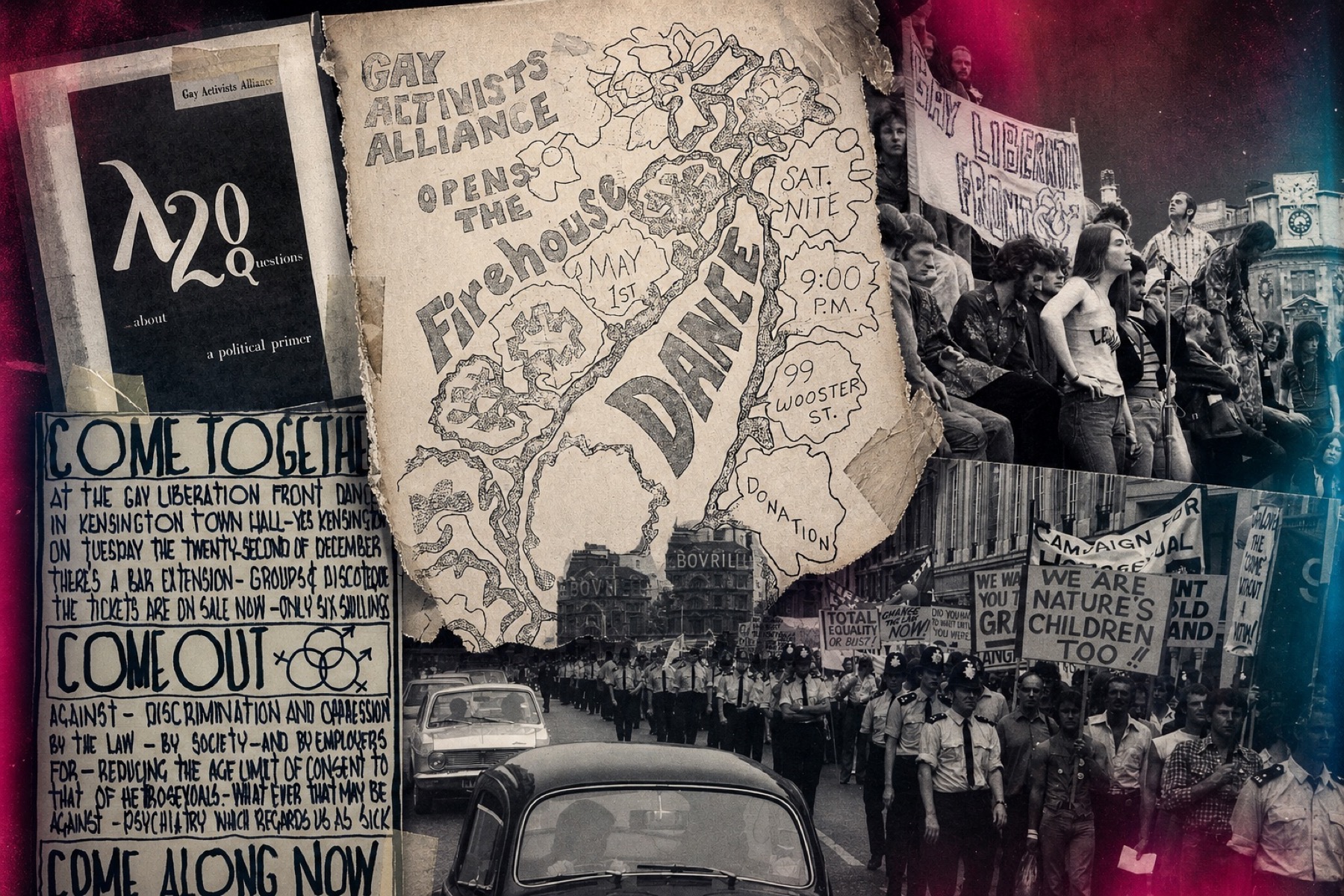
Ticket for a queer community Halloween benefit dance, Britain, 1970s. LSE Library / Flickr Commons, no known copyright restrictions, via Wikimedia Commons. This is not a GAA document; it shows the formula “dance + political benefit” circulating across the liberation movement on both sides of the Atlantic.
The Pleasure Committee was not a joke. It was political economy.
Within the Firehouse structure, a Pleasure Committee organised dances and social activities.
The name is brilliant because it refuses the puritan separation between serious work and suspicious pleasure.
Political movements are often tempted to believe suffering proves seriousness. The longer the meeting, the uglier the light and the more insulting the coffee, the nobler the cause appears.
The Firehouse offered another model.
Pleasure could be organised.
Organisation could finance power.
And power could be exercised without everyone wearing the same expression of civic bereavement.
Nor should everything be romanticised. GAA was frequently criticised for white male dominance and for a more reformist strategy than other groups. Lesbians often had to build their own structures; conflicts over race, gender and class did not dissolve beneath a mirror ball.
The Firehouse did host groups and events that widened the scene, including the Black Lesbian Caucus, later known as Salsa Soul Sisters, one of New York’s first organisations for lesbians of colour.
A dance floor can liberate one body and exclude another on the same night.
That does not cancel its power.
It makes it history rather than advertising.
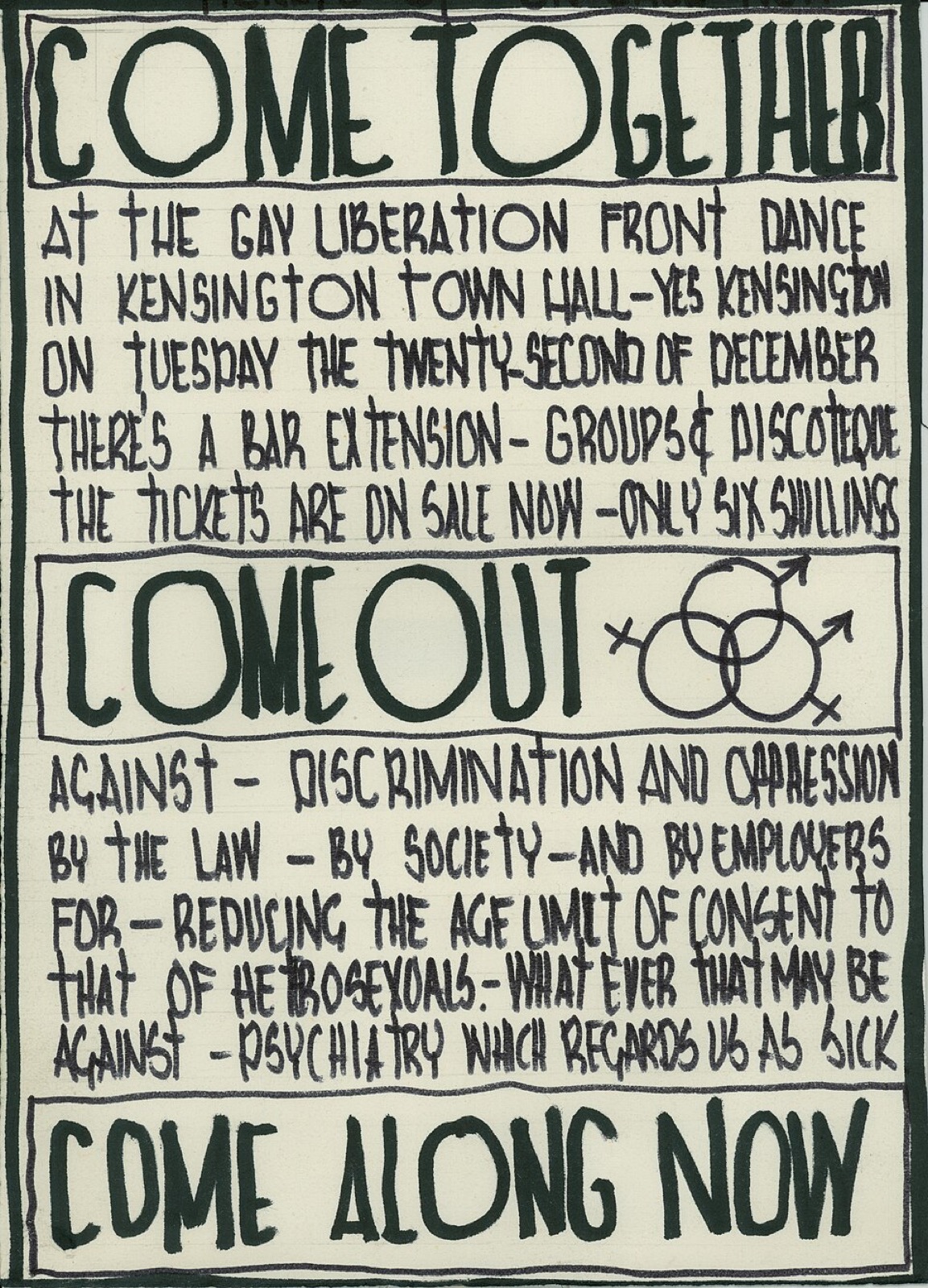
Flyer for the first GLF dance at Kensington Town Hall, London. LSE Library / Flickr Commons, no known copyright restrictions, via Wikimedia Commons. A British image used here to show the same transatlantic grammar: come to the dance, come out against discrimination.
Did the Firehouse invent disco?
No.
And it would be a shame to replace one simplified history with another merely because the second wears more progressive shoes.
The history of disco before Hollywood gave it a single protagonist includes David Mancuso’s parties at The Loft, Black and Latino clubs, queer bars, DJs experimenting with continuous mixing and communities building the language of the night before the industry knew it would soon package that language as disco.
The Firehouse was one piece of that infrastructure, not the exclusive womb of the genre.
What it demonstrated with remarkable clarity was that a dance floor could be a political institution. Not only the setting of freedom, but its financial and social mechanism.
At a time when same-sex dancing was still watched, discouraged or used by authorities against venues—and when the exact history of New York’s dance rules is more complicated than the convenient slogan “it became legal in 1971”—having one’s own hall meant control.
Control over the door.
Control over the music.
Control over the money.
Control over the gaze.
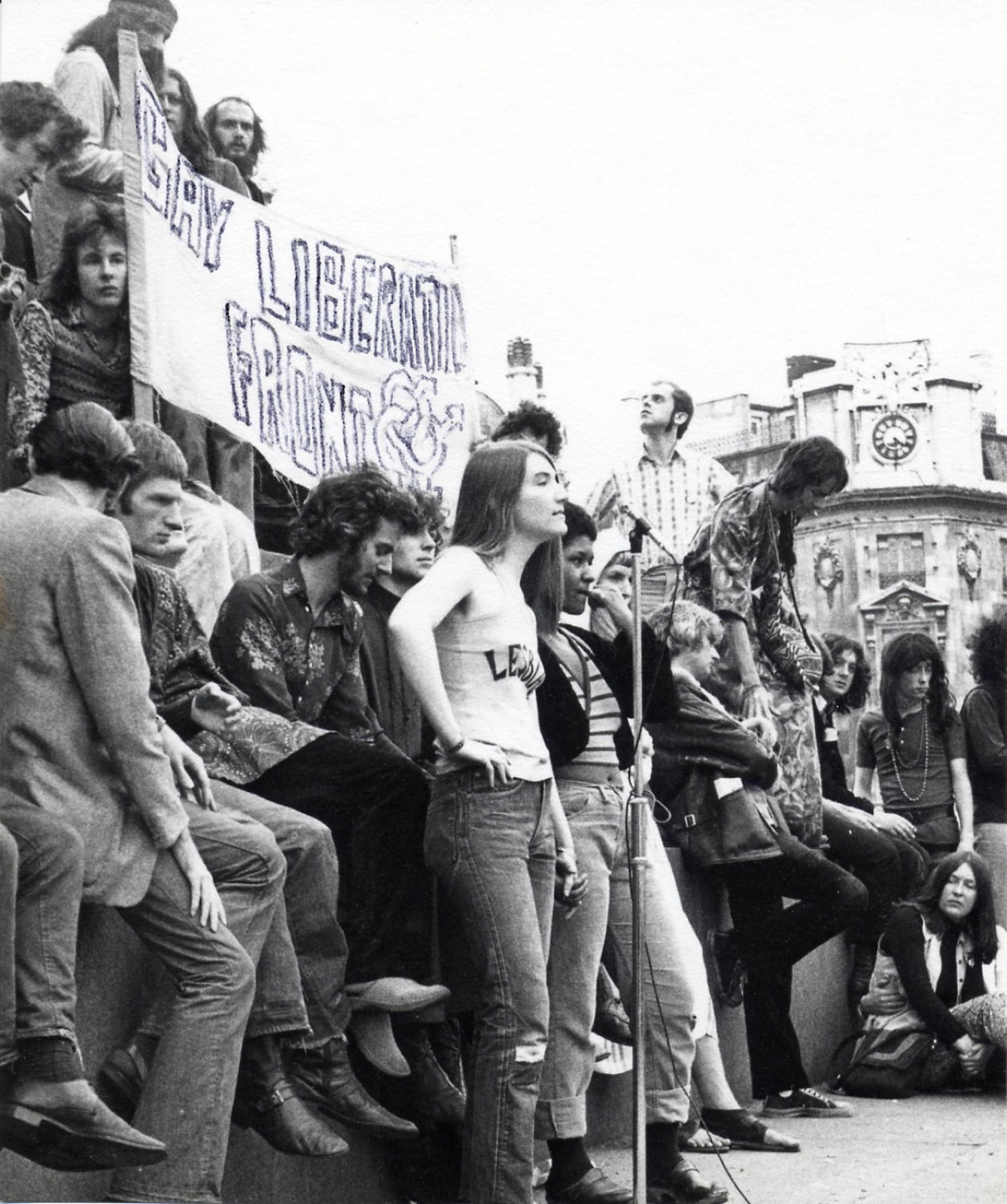
Gay Liberation Front demonstration, Trafalgar Square, London, 1971. LSE Library / Flickr Commons, no known copyright restrictions, via Wikimedia Commons. This is London, not New York; the movement was already speaking an international language of bodies refusing shame.
Vito Russo and Friday-night cinema
Before writing one of the foundational books about images of homosexuality in Hollywood, Vito Russo programmed films at the Firehouse.
The detail is almost too beautiful.
In the same building where people built political power, Russo learned to read how cinema had made them visible, monstrous, comic or disposable. On Friday he projected films. On Saturday the community projected itself onto the dance floor.
Russo later became a co-founder of GLAAD and an ACT UP activist. He died in 1990, aged 44, from AIDS-related complications. Film, activism and dancing are not unrelated chapters in his biography. They are different methods of controlling who tells the story and who remains in frame.
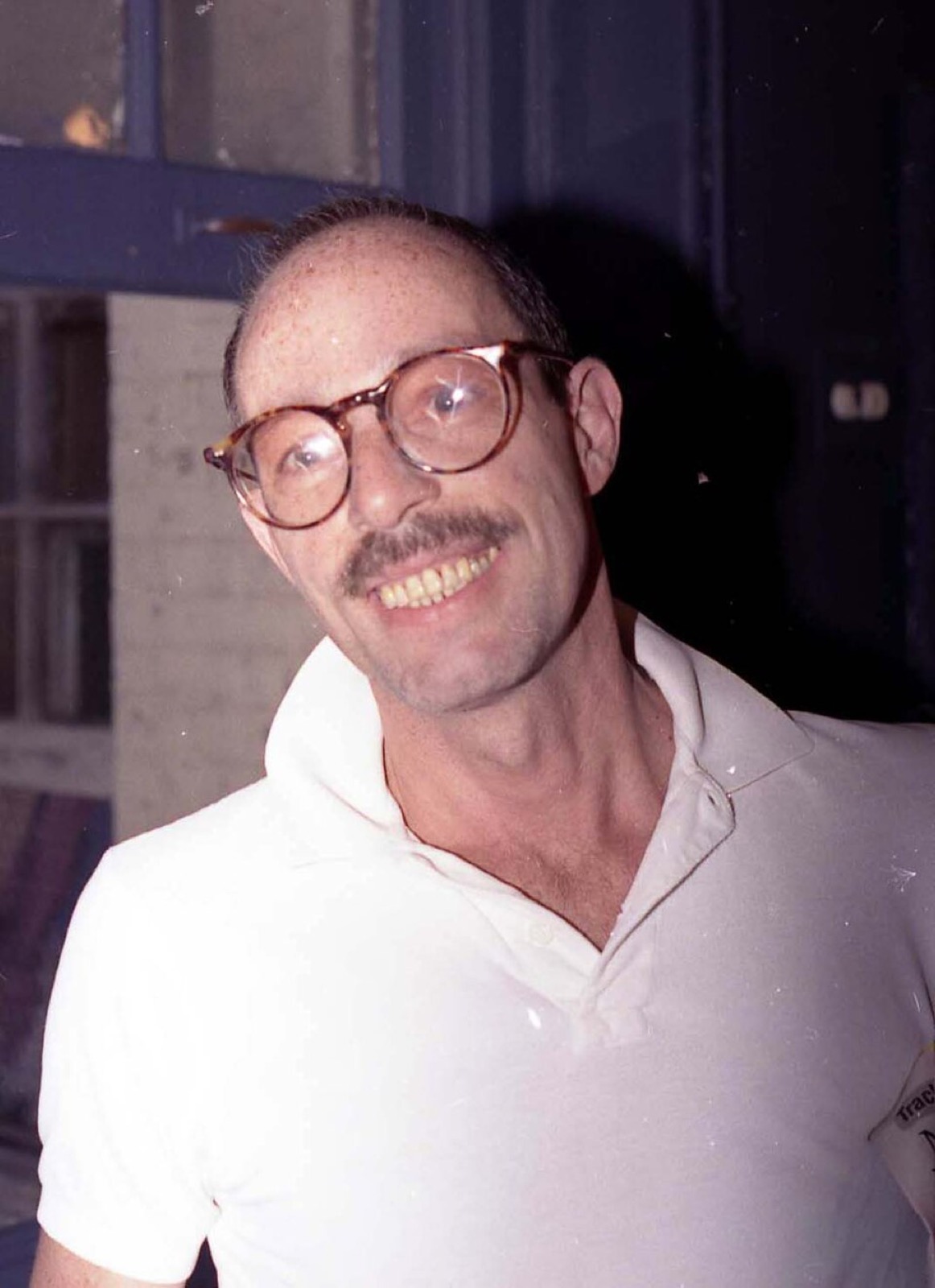
Vito Russo in New York, June 28, 1989. Photograph: Massimo Consoli, CC BY-SA 2.5, via Wikimedia Commons. A year before his death, his gaze already knew the price of remaining visible.
October 15, 1974: fire closes the building, not the formula
On the night of October 15, 1974, the Firehouse interior was destroyed in an arson attack. Furniture and equipment burned; the organisation lost the headquarters that had given it critical mass. GAA leader Morty Manford described the incident in the context of persistent harassment.
The building could no longer function.
The formula could.
In the decades that followed, queer communities used parties, clubs, balls and benefits to fund hotlines, legal services, AIDS care, artists, organisations and protest. Sometimes the night was the only welfare state that answered the phone.
But the formula’s success also produced its corporate imitation. Today many events “celebrate the community” while the community buys the sponsor’s drink and receives, in exchange, a rainbow logo valid until July 1.
The difference is simple:
At the Firehouse, the party funded the politics.
In many contemporary campaigns, politics decorates the party.
They are not the same, even when the magenta light is excellent in both.
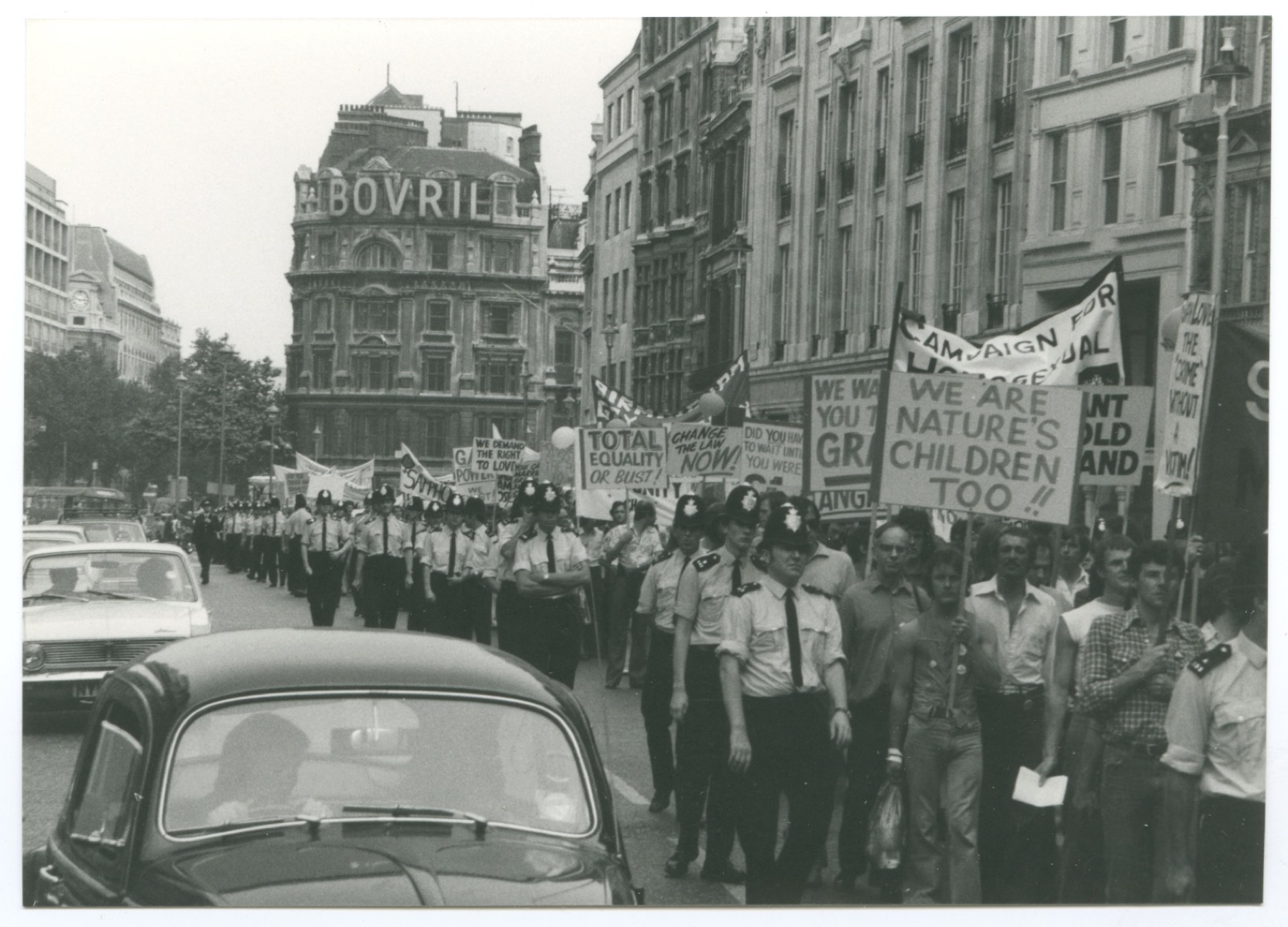
Gay Pride March, London, 1974. LSE Library / Flickr Commons, no known copyright restrictions, via Wikimedia Commons. In only a few years, the basement meeting had become a crowd in the street. The police were still there; now they were inside the photograph too.
From Wooster Street to Sitges, without invented genealogies
I will not pretend that a night in Sitges descends directly from the Firehouse. Queer culture does not need invented genealogies; it has enough complicated families without editorial assistance.
But there is an authentic connection between this history and the world of Cruel Sitges: night is not the pause between two serious days. It is where a community negotiates freedom, desire, memory and sometimes survival.
A good dance floor is a temporary constitution.
It tells you who may enter.
Who may look.
Who may touch.
Who pays.
And who receives the money when the lights come on.
That is the question nostalgia avoids. We love remembering the music. We are less enthusiastic about following the banknote.
At the Firehouse, its route was remarkably clear: from the door to the organisation, from the organisation to pressure, from pressure to a change that would take years.
Perhaps this is why the story remains so seductive.
It does not merely say gay people danced while they fought.
It says dancing was one form of the fight.
What remains after the lights come up
GAA dissolved in 1981. The city bill passed in 1986. Vito Russo died in 1990. The building at 99 Wooster was converted, like so many radical addresses, into property expensive enough to make its history seem nearly indecent to the market.
A few years later, the anti-disco backlash would try to force this culture back underground, without stopping its mutation into house.
The archives remained.
The flyers.
The minutes.
The photographs.
The testimony of people who remember that admission was two dollars.
And a lesson contemporary activism should print above every fundraising form:
The community is not the cause’s audience.
The community is its infrastructure.
The Firehouse did not ask dancers to choose between pleasure and politics. It showed them that pleasure could produce money, money could produce organisation, and organisation could produce enough pressure to stop power sleeping peacefully.
Sometimes literally, after one in the morning.
The revolution had a cashier.
The cashier had a strobe light.
And on Saturday night, at 99 Wooster Street, freedom paid its own bill.
Sources and archives consulted
- National Park Service — Gay Activists Alliance Firehouse
- NYC LGBT Historic Sites Project — GAA Firehouse
- LaGuardia and Wagner Archives — Gay Activists Alliance
- New York Public Library — Gay Activists Alliance records, 1969–1983
- The LGBT Community Center — The Firehouse
- NYC LGBT Historic Sites Project — zap at Saul Sharison’s residence
- PBS — Disco: Soundtrack of a Revolution, “A Political Statement”
- Cambridge University Press — Liberation on the Dance Floor