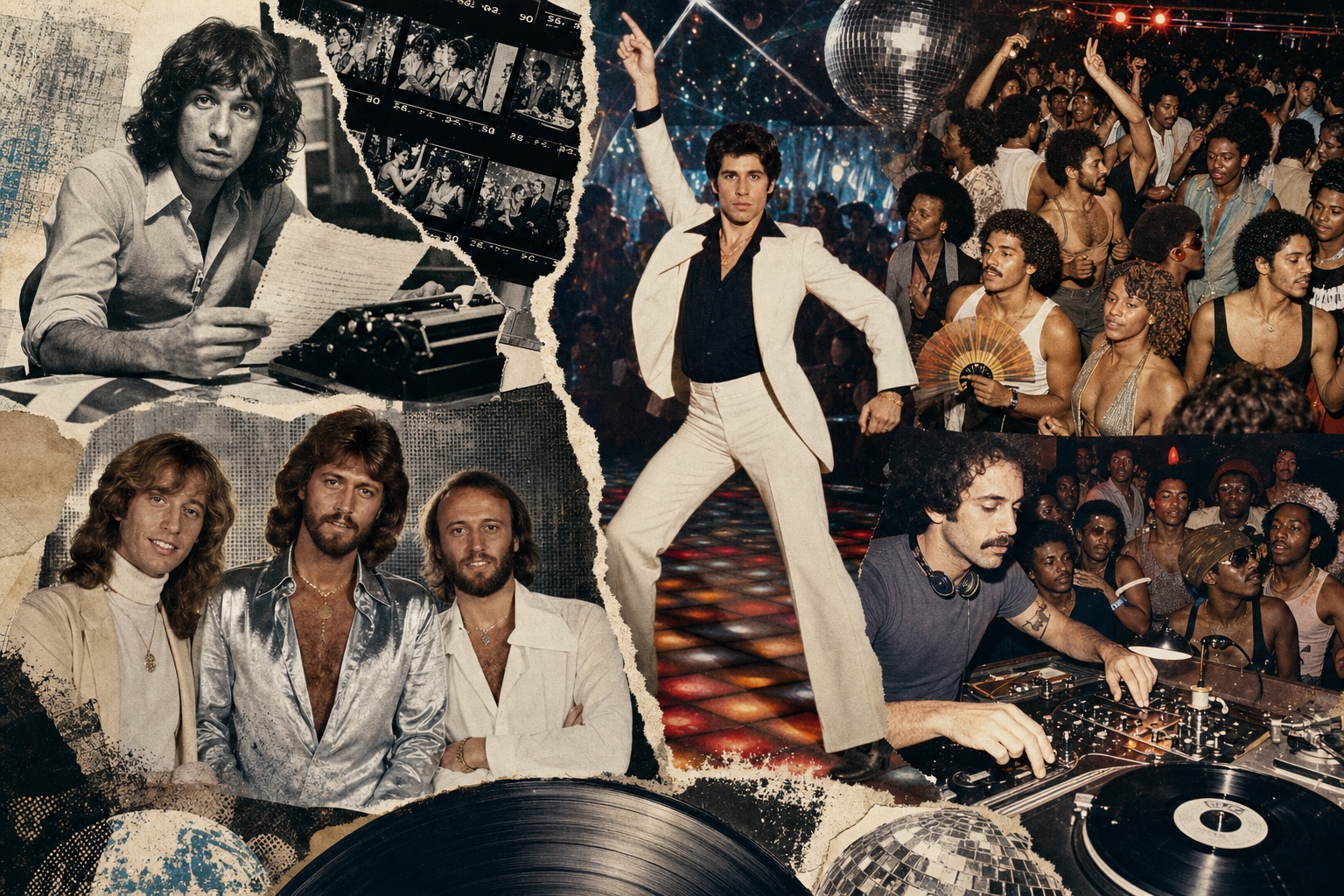
A journalist invented a guy. Hollywood turned him into John Travolta. The Bee Gees came later. And a few months after that, the whole world was convinced it knew what disco looked like.
In 1994, British journalist Nik Cohn admitted something rather uncomfortable about the article that had changed his career:
“My story was a fraud.”
Five words.
Very efficient.
Especially when you say them almost twenty years after your “fraud” has become one of the best-known films in the world.
The problem with a small lie is that sometimes it dies quickly.
The problem with a lie that is well dressed, beautifully danced and set to the Bee Gees is that it can become pop heritage.
And that is exactly what happened.
June 7, 1976. Brooklyn. Or close enough.
That day, New York magazine published an article whose title sounded anthropological enough to inspire instant trust:
“Tribal Rites of the New Saturday Night.”
Author: Nik Cohn.
The apparent subject: young Italian Americans in Bay Ridge, Brooklyn, for whom Saturday night was religion, the dance floor an altar, and a sharply pressed suit probably a form of constitutional right.
The central character was Vincent.
Young.
Working-class.
Macho.
Obsessed with dancing.
A little king of the night.
The perfect social animal for a magazine.
Except that Vincent, in the form Cohn presented to his readers, did not exist.
He had not been followed by the reporter for months.
He was not an ethnographic case study.
He was not a man the journalist had met in a club and whose life he had rigorously reconstructed, bill by bill, friend by friend, dance by dance.
Cohn would later admit that the protagonist was a composite, partly inspired by a mod he had known years earlier in Shepherd’s Bush, London, a kind of local king of Goldhawk Road. The AFI Catalog explicitly records the later admission that the story was fabricated and that Vincent was built from composite characters.
So Brooklyn was real.
The clubs were real.
The people were real.
The dancing was absolutely real.
Only the central hero suffered the minor inconvenience of being largely imaginary.
Detail.
It happens in journalism.
The complicated part is generally when the magazine tells its readers the material is factual.
Disco already existed. Quite successfully, in fact.
That is the part that makes the story more interesting.
Nik Cohn did not invent disco.
Not even close.
By the time his article appeared in the summer of 1976, New York disco culture already had a serious history.
June 1969: Stonewall accelerates the gay liberation movement.
February 14, 1970: David Mancuso holds the Love Saves the Day party at 647 Broadway, the nucleus of what will become The Loft.
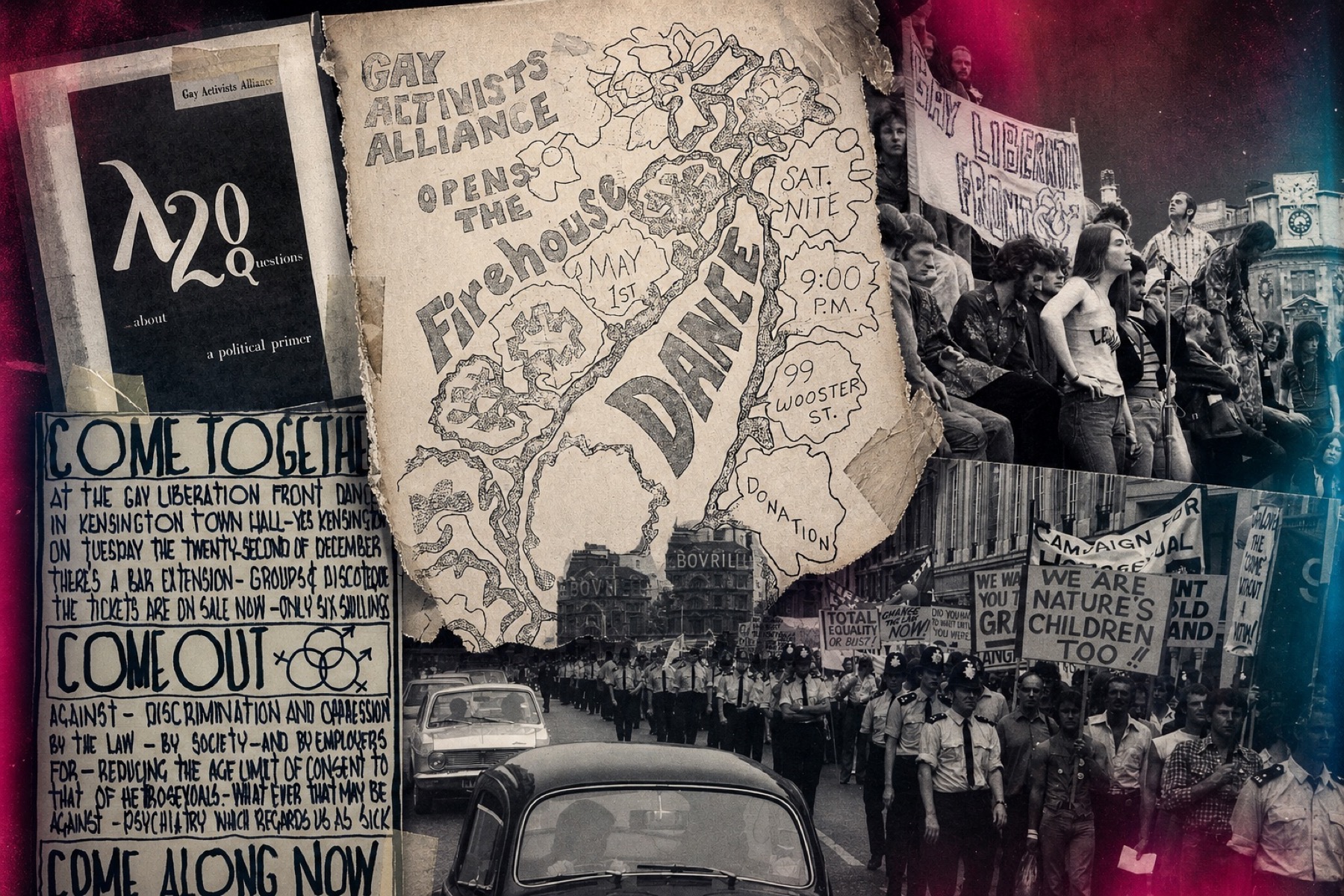
May 1971: the Gay Activists Alliance opens the Firehouse at 99 Wooster Street, where weekly dances come to finance activism.
1973: Nicky Siano opens the Gallery.
1974–1975: tape edits, continuous mixes, experiments with the 12-inch format.
June 1975: the New York Record Pool appears.
Disco had not yet been standardised as a genre, but a network of clubs, DJs, musicians, dancers, labels, technology and money was already in place. Black, Latino, gay, queer, female and straight audiences participated in this world in different proportions. The Firehouse’s history is documented by the National Park Service, while music historian Tim Lawrence reconstructs the role of The Loft and Mancuso in the disco ecosystem in Love Saves the Day.
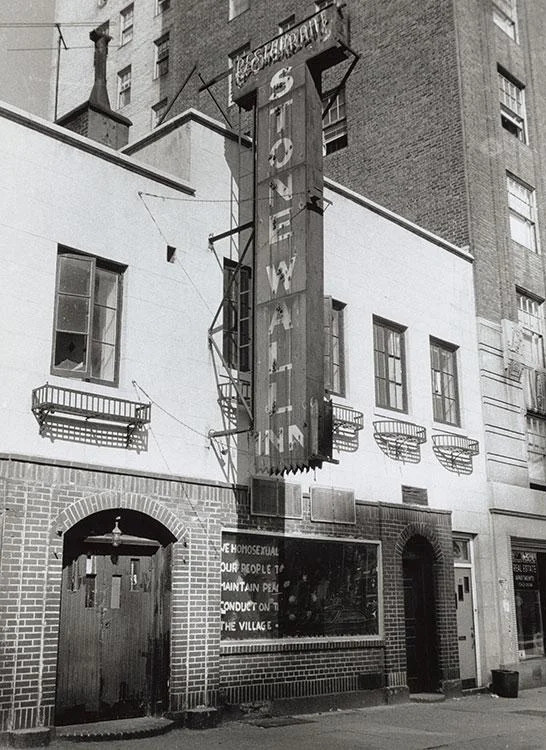
The Stonewall Inn in 1969. National Park Service archive image, public domain, via Wikimedia Commons.
In other words, by the time Cohn arrived at the table, dinner had already been served.
He merely decided who deserved to be placed on the cover.
Four days later, Hollywood says: I’ll buy it.
This is where the story becomes almost comical in its speed.
The article appears on June 7, 1976.
On June 11 — four days later — The Hollywood Reporter announces that producer Robert Stigwood has already bought the film rights.
Four.
Days.
Not four months.
Not “after the article became a cultural phenomenon and was studied in depth.”
Publish on Monday. By Friday, Hollywood has its card out.
AFI confirms the timeline and notes that Stigwood initially hired Cohn himself to adapt it, although he would not be credited as a screenwriter on the final film. The screenplay went to Norman Wexler.
Today we talk about virality as if we invented it along with the phone.
In 1976, Robert Stigwood was analog scrolling with absolutely admirable efficiency.
Four days.
The fake news had not even had time to cool down.
Then Vincent gets an upgrade
In the process of adaptation, Vincent becomes:
Tony Manero.
By September 22, 1976, the trade press was already announcing John Travolta’s deal with Stigwood: three films, approximately $1 million.
Travolta was not yet the god in a white suit we know today.
He was a television actor at precisely the moment when his career could explode.
And the explosion came.
Principal photography for Saturday Night Fever began on March 14, 1977.
The New York locations were wrapped by the end of May.
The film reached cinemas on December 16, 1977. AFI Catalog
Approximately eighteen months.
That was all it took for a composite character in a magazine article to become John Travolta and start redefining for the planet what a man should look like when he points one finger at the ceiling.
Efficient marketing.
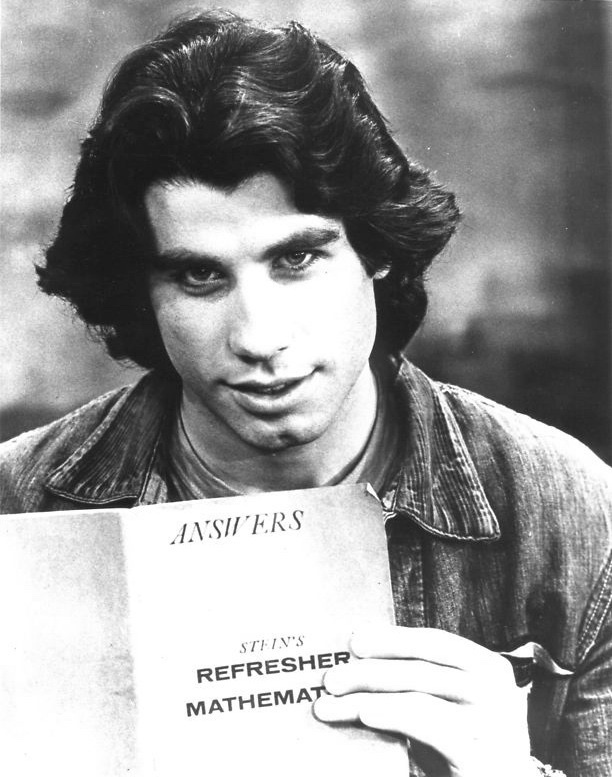
John Travolta one year before the film’s premiere. ABC Television publicity photograph, public domain, via Wikimedia Commons.
And the Bee Gees?
This is where our cultural memory performs a neat trick.
Today it seems almost impossible to separate:
John Travolta + white suit + Bee Gees + disco ball.
As if all four had hatched simultaneously from a gigantic polyester egg.
Except they did not.
The Bee Gees did not build the film from the beginning.
They entered the equation decisively in post-production.
During filming, Travolta had rehearsed and danced to music by Stevie Wonder and Boz Scaggs, among others. Some sequences had already been choreographed before the soundtrack we now consider inseparable from the film took its final form. Travolta later described the process in the oral history published by Vanity Fair, while the National Recording Registry essay reconstructs the Bee Gees’ contribution.
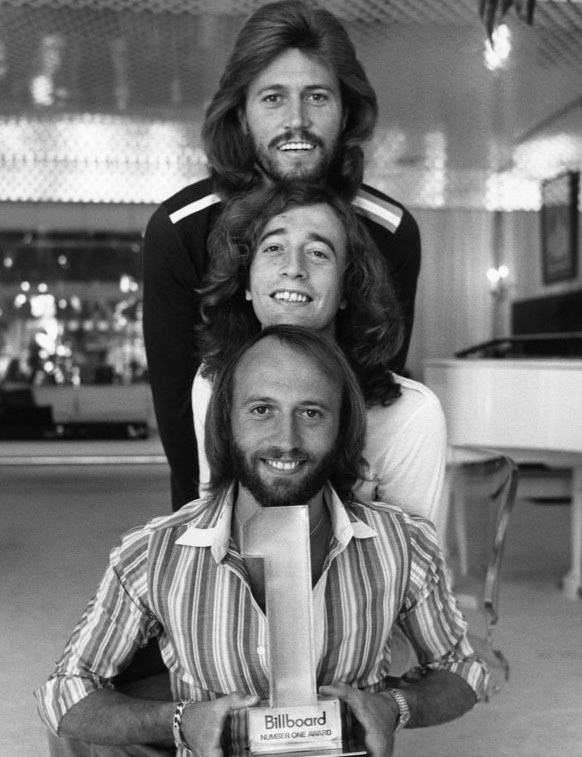
The Bee Gees in 1977. NBC Television publicity photograph, public domain, via Wikimedia Commons.
That means our retrospective image is more compact than reality.
Much more compact.
To us, everything looks inevitable.
Travolta had to dance to the Bee Gees.
The Bee Gees had to sing Stayin’ Alive.
Disco had to look exactly like that.
History, however, knew none of this yet.
History was improvising.
We are the ones who add the perfect beat afterwards.
Disco’s real protagonist did not fit neatly on a poster
And this, I think, is where the important story begins.
Because the problem is not merely that Nik Cohn invented a character.
The problem is why his character worked so well.
Underground disco was difficult to narrate.
Who was the protagonist?
David Mancuso?
Francis Grasso?
A producer in Philadelphia?
A Black dancer?
A Puerto Rican kid doing the Hustle?
A gay man who, for the first time, could dance without performing a heterosexual rule?
A woman running the club?
The DJ?
The speakers?
The crowd?
The annoying answer is:
all of them.
Disco was a sentence in the plural.
An ecosystem.
The DJ read the floor.
The floor answered.
The label listened to the DJ.
The producer lengthened the track.
The engineer changed the record.
The dancer decided whether the invention worked.
And in the morning, everyone went home a little different.
Culturally excellent.
Terrible for a poster.
Hollywood needs something else.
Hollywood says:
Give me a boy.
Handsome.
Conflicted.
Sexual.
Instantly recognisable.
And ideally, he should know how to dance.
That is how Tony Manero appears as a perfect unit of compression.
Club culture was a sentence in the plural. Hollywood gave it a single subject.
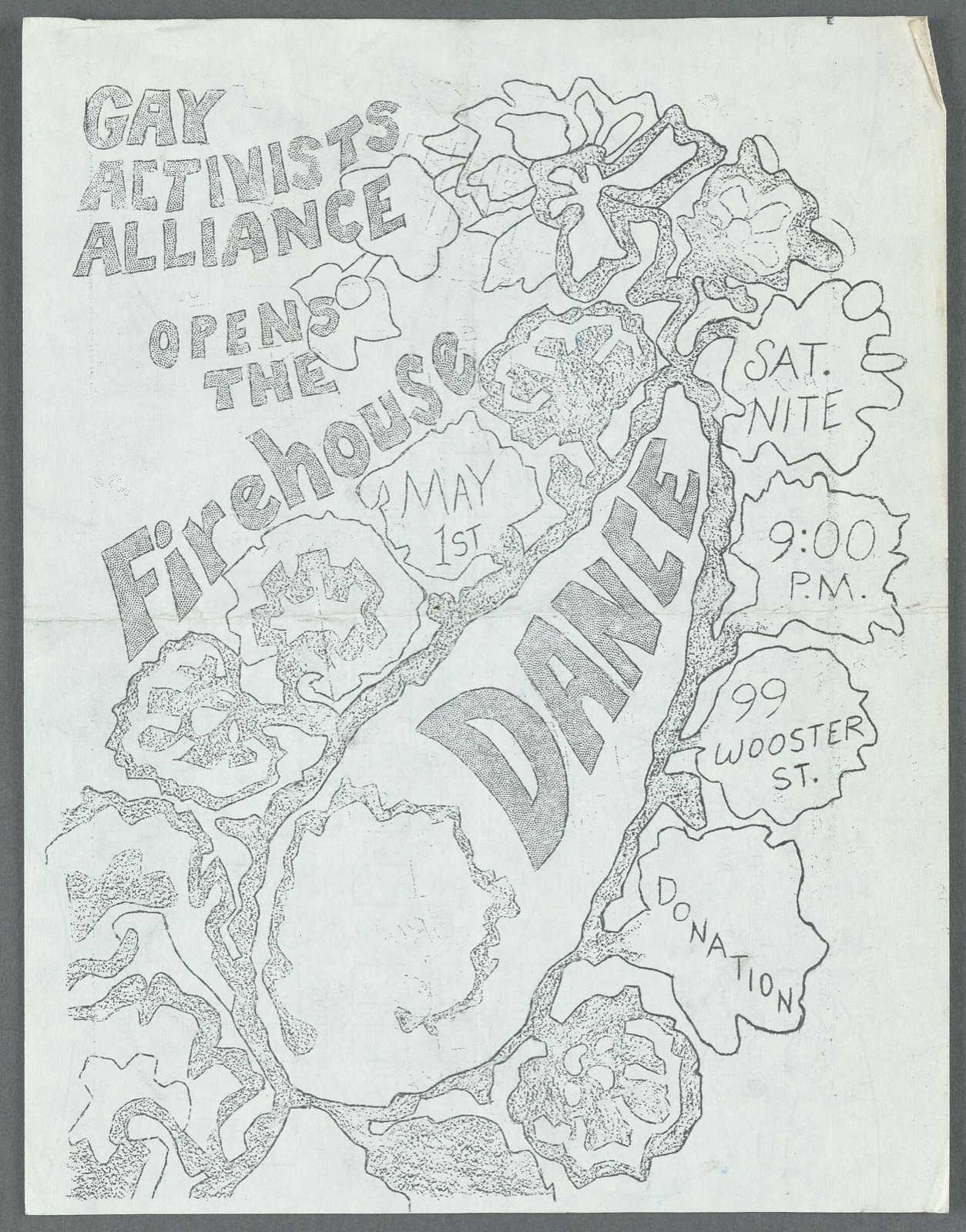
Flyer for the opening of the Firehouse Dance, May 1, 1971. Gay Activists Alliance, CC0, via Wikimedia Commons.
And, obviously, the subject looked very good
Let us not be hypocrites.
John Travolta in Saturday Night Fever is magnetic.
He walks as though the pavement belongs to him.
He dances as though gravity has been notified that it is suspended until Monday.
He is macho, vulnerable, ridiculous, seductive and occasionally unbearable in the same scene.
Exactly the right amount for cinema.
That explains part of the success.
But there is also a subtle cultural shift.
In many of the underground spaces that built disco, the protagonist was the dance floor.
In the film, the protagonist is Tony’s individual body.
In many early queer spaces, dancing could loosen the idea of the heterosexual couple as a compulsory unit.
In the film, the story becomes intelligible through a young, straight, white Italian American man.
It is not necessarily a conspiracy.
It is translation.
But every translation decides what to keep.
And what to leave out.
The mainstream could whiten and heterosexualise certain narratives, yet it simultaneously produced visibility, jobs, access and global circulation for music and artists who would otherwise have remained far more restricted.
So no:
underground = pure and good.
Hollywood = evil and thieving.
Life is rarely polite enough to give us villains that simple.
Then the invented story starts beating reality by the numbers
In 1978, the Saturday Night Fever soundtrack spends:
24 weeks at No. 1 on the Billboard 200.
It generates:
4 No. 1 singles.
And reaches:
5 Grammys, including Album of the Year.
The Recording Academy documents the 24 weeks and Grammy victories, while the Library of Congress lists the four chart-topping singles.
Twenty-four weeks.
There are 52 in a year.
That means that for almost half a year, America opened Billboard and found the same fever waiting there.
It was no longer a subculture.
No longer merely a club.
No longer New York.
It was fashion.
Cinema.
Radio.
Grammys.
Flared trousers.
Falsetto.
Advertising.
Imitation.
Parody.
Grandma roughly knew what disco was.
At that point, Tony Manero no longer represented only a character.
He had begun to represent the image.
And the image almost always wins
This is where it becomes a little sad.
And beautiful.
And ridiculous.
Disco’s real history was scattered across:
flyers,
membership cards,
acetates,
DJ lists,
recordings,
badly exposed photographs,
memories belonging to people who did not know someone would one day consider their night “cultural history.”
They did not all have contracts.
They did not all have photographers.
They did not have PR.
Many did not even want their names preserved anywhere.
They were busy living.
That is a major problem for an archive.
The star archives beautifully.
Infrastructure, much less so.
In 2024, the Smithsonian purchased a collection of New York disco ephemera, processed in 2025.
Its size?
0.25 cubic feet.
One box.
Yet that box contains 25 folders, focused especially on clubs and spaces for Black audiences that appear far less frequently in popular disco history. Smithsonian Institution
Think about the contrast for a moment.
John Travolta occupies screens around the world.
A part of the real history fits inside a box.
That is how memory works.
It does not necessarily preserve what mattered most.
It preserves what was easiest to preserve.
Incidentally, Cohn was not quite as naive as our story would conveniently like him to be
It would be very easy to turn Nik Cohn into the idiot who walks into Brooklyn, sees a few Italians dancing and says:
“Aha! I have discovered disco.”
Except that is not what happened.
Cohn knew the Bay Ridge scene was only one part of a much larger culture.
During his reporting, the guide Tu Sweet had explained the route through Black gay clubs, Black straight audiences, white gay, Latino and West Indian crowds, and then Brooklyn’s Italian American communities.
In other words, Cohn could see the circulation.
He knew the world he was describing had not been born there.
And perhaps that is precisely what makes his choice more interesting:
from all those bodies and histories, he finds a story that can be told through one boy.
Not necessarily because it was the complete truth.
But because it was an excellent story.
And excellent stories have this lack of common sense:
sometimes they refuse to let the truth ruin their rhythm.
So did Saturday Night Fever “steal” disco?
Not quite.
That would be a lazy conclusion.
The film itself contains a great deal of reality.
Brooklyn is real.
The locations are real.
The class tensions are real.
Tony’s masculinity is recognisable.
His ambition to escape the world into which he was born is entirely real.
The film is also dark — much darker than later nostalgia, with its white suits and glitter, sometimes allows us to remember.
And the soundtrack?
It is excellent.
This is where simple morality becomes complicated.
Because something can be produced through an imperfect translation of a culture and still be very good art.
Culture is not a criminal trial.
We do not always have a victim, an offender and the murder weapon in a transparent bag.
Sometimes we have:
influence,
compression,
market,
seduction,
forgetting,
and a song so good that the argument has to continue after you finish dancing.
The mainstream does not only steal. The mainstream simplifies.
That, I think, is where the real story lives.
Subcultures are complicated.
They have contradictions.
Clubs that liberate one body can exclude another.
Marginalised communities can reproduce their own hierarchies.
A Black culture can become queer space.
A queer space can privilege white men.
A straight woman can write a gay anthem.
A European producer can alter the future of an American genre.
Everything gets messy the moment you look closely enough.
The mainstream has a different problem:
it needs to sell the story by Friday.
So it simplifies.
It takes the network.
Gives it a face.
Takes the crowd.
Gives it a protagonist.
Takes history.
Gives it a soundtrack.
Takes contradiction.
Gives it a poster.
And it works.
God, how well it works.
In 1994, Nik Cohn tells the truth
And we return to where we began.
After almost two decades, Cohn admits:
“My story was a fraud.”
You can correct an article.
You can publish a note.
You can explain in retrospect that Vincent was a composite.
You can say that some scenes were observed, others condensed, others invented.
But how do you correct what happened afterwards?
How do you remove John Travolta from collective memory?
How do you explain to a billion images that disco was far bigger than the white suit?
How do you send an erratum to 24 weeks of Billboard?
To the Grammys?
To the weddings where people danced to Stayin’ Alive?
To the millions of people for whom disco began exactly there?
You cannot.
Because sometimes truth reaches the archive.
And fiction reaches the dance floor.
Nik Cohn admitted that the story had been a fraud. His confession was published in 1994.
Only by then the planet had bought the soundtrack.
And in 1979, when success became a target, the story continued in the night the industry declared disco dead.
Return policy expired.