If Romanian folklore had film credits, they would probably look like this:
Romania — director.
The People — screenplay.
The Eternal Village — visual concept.
Tradition — music.
And somewhere after the cleaner and before the thanks to city hall, perhaps:
Romani lăutari — special collaboration.
If there is room.
Not because they were marginal to the sound the Romanian state called, at different times, “national,” “popular” or “authentic.” They were so central that their presence became infrastructure. Infrastructure has terrible public relations: everybody uses it; almost nobody invites it to the premiere.
This is not the simplistic story in which Roma “invented” every Romanian melody. Music travels too efficiently for such property deeds. It is the more accurate — and less comfortable — story of who memorised the repertoire, carried it from court to tavern and from wedding to World’s Fair, adapted it to new instruments, and who eventually received the institutional signature.
In short:
The lăutari built the network.
The state bought the frame.
Then posed beside the painting.
A credit sequence that begins before freedom
Roma were enslaved in Wallachia and Moldavia for roughly five centuries. Documentary sources place lăutari in noble and monastic households from at least the late fifteenth century in the south of present-day Romania and the late sixteenth century elsewhere. They made music for aristocracy and clergy while legally being someone’s property.
The situation is almost too perfect a preview of what culture would later do:
The sound was desirable.
The person making it was negotiable.
The Council of Europe documents five centuries of slavery, while research published in Folklorica follows enslaved lăutari through elite households. Abolition did not arrive in one enlightened morning, but through laws passed between 1843 and 1856.
Moldavia’s final emancipation law was voted on 22 December 1855 Old Style / 3 January 1856 New Style. In Wallachia, the final law came on 8/20 February 1856. The Romanian Cultural Institute cites an estimate of around 250,000 people freed.
Freedom on paper.
In life, little or no land, compensation paid to owners rather than the formerly enslaved, and a society whose law had changed faster than its reflexes.
Slavery ended legally.
The historical invoice did not.

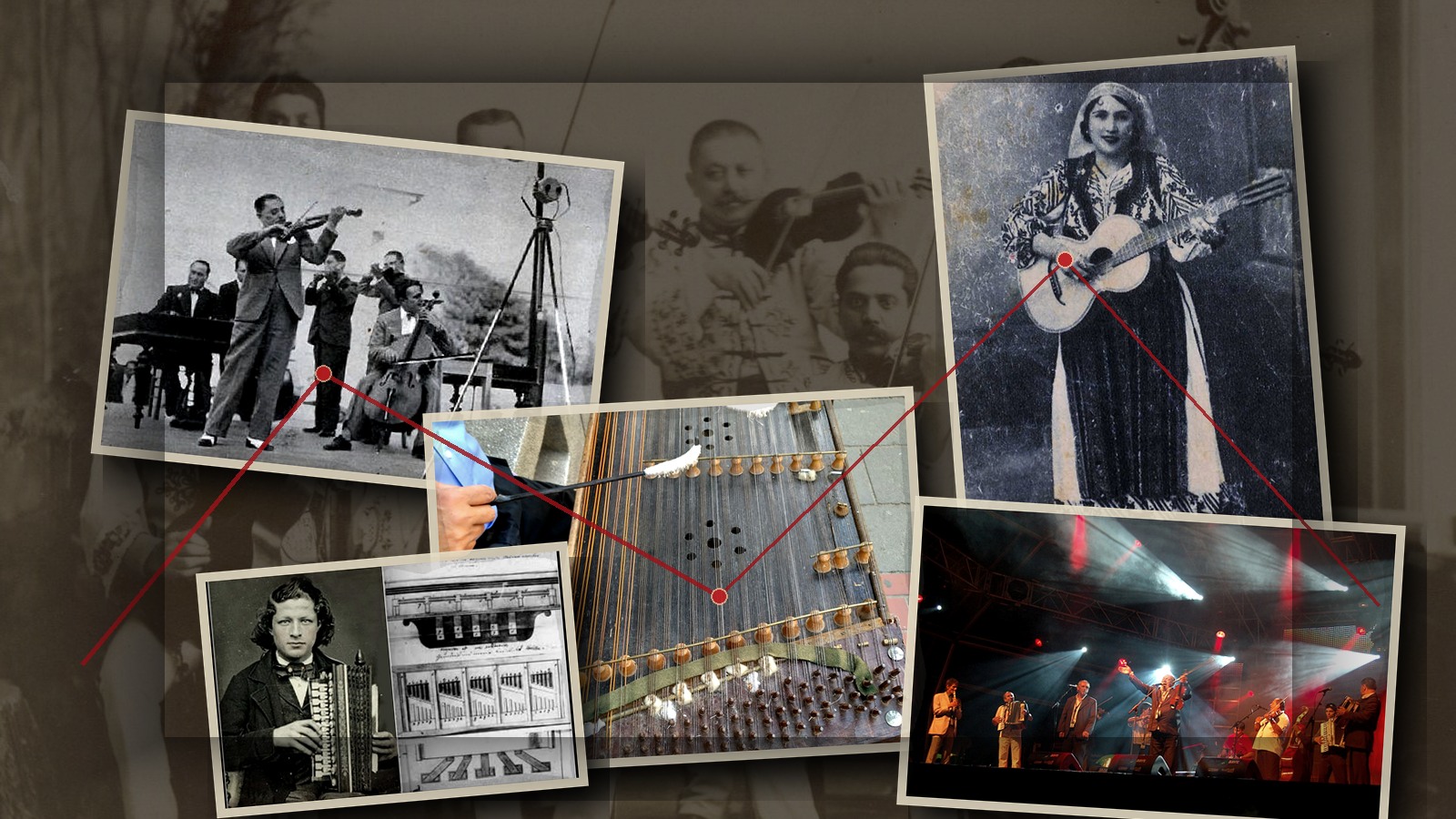
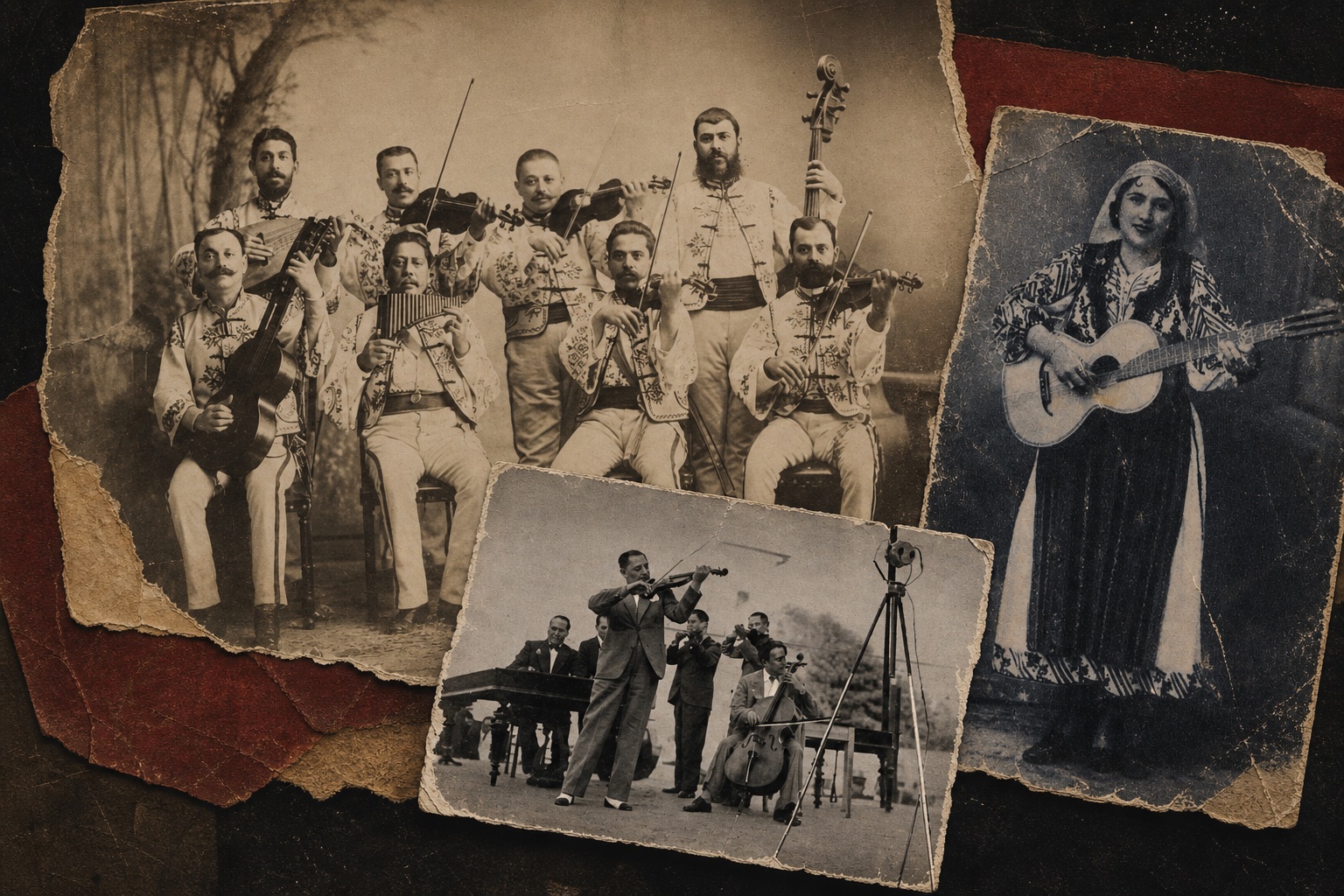
Ionică Dinicu’s band at the Romanian section of the Paris Universal Exposition, 1889. Photograph: Paul Nadar / Gallica, public domain, via Wikimedia Commons. Romania was already exporting its image through musicians national memory would often present without ethnicity.
In 1848, the lăutar becomes Romanian — exactly as much as required
While the modern nation was being assembled, the 1848 generation discovered that the lăutar was remarkably useful. RomArchive records the paradox: around 1848, lăutari could be hailed as custodians and transmitters of Romanian spirituality while their status as slaves and Roma participation in national culture were pushed out of frame.
It is a very elegant edit.
Keep the violin.
Cut the chain.
Keep the melody.
Cut the biography.
Keep the costume.
Cut the person who knows why the tune changes after the third bottle and why a groom in one village asks for a different cadence from a merchant in the next mahalle.
An Oxford study published in 2024 describes two oral traditions practised by professional lăutari in the late nineteenth and early twentieth centuries. Arii naționale, “national airs,” could become emblems of the middle class and nation. Muzica lăutărească, or music of the mahalle, remained racially and occupationally marked.
The same musicians could produce both the national emblem and the sound considered too impure for the salon.
It depended on who listened.
More importantly, on who wrote the label.
The photograph of Ionică Dinicu’s ensemble in Paris in 1889 is an X-ray of the mechanism: nine Romani lăutari, photographed by Paul Nadar, represent Romania’s pavilion. Romanian enough for the pavilion.
Much less Roma in the story later told about it.
Four instruments with indecently international passports
The myth of pure folklore has a logistical problem: instruments have never shown passports at the border.
Tárogató: Hungarian on paper, Romanian in accent
The modern tárogató — capable of sounding like a love complaint by someone too proud to cry — did not descend intact from Dacia.
Its modern clarinet-like form was reinvented by Vencel József Schunda and manufactured by János Stowasser in the 1890s. According to the University of Music and Performing Arts Vienna, lăutar Luță Ioviță introduced it to Banat in the 1920s, and it spread into Țara Moților in the 1950s.
Its industrial origin is Austro-Hungarian.
Its sonic biography becomes Romanian through the musician.
The nation is not in the screw.
It is in the breath that decides what to do with it.

Tárogató from the Auckland War Memorial Museum collection. Photograph: Auckland Museum, Wikimedia Commons, CC BY 2.0.
Cimbalom: a thousand strings and a very un-Mioritic patent
The cimbalom has old relatives across several cultures, but the large pedal concert instrument was standardised by Schunda in 1874 in Budapest. The Hungarian Intellectual Property Office notes that his workshop employed 9 workers and 5 apprentices in 1873, rising to 45 workers in 1898.
An example made after 1874 at the Metropolitan Museum of Art measures approximately 142 centimetres along its long side, 75 centimetres wide and 75 centimetres high.
This is not a rustic object that accidentally wandered into the orchestra.
It is industrial music technology, adopted, domesticated and taught to speak locally.
Pedal cimbalom, after 1874, workshop of V. J. Schunda. The Metropolitan Museum of Art, object 43.124a–l, Open Access / public domain.

Cimbalom in Bucharest, 2 June 2018. Photograph: Jo Dusepo, Wikimedia Commons, CC BY-SA 4.0.
Accordion: Vienna, May 1829
In May 1829, Armenian maker Cyrill Demian and his sons received a two-year Vienna patent for an instrument named “Accordion.” Vienna’s city archive explains how the single-bellows instrument travelled along commercial and maritime routes until it became global.
The lăutari did not invent the accordion.
They did something more important for living culture:
They hired it.
They gave it repertoire, ornament, breath and enough wedding work that it could no longer pretend to be merely Viennese.
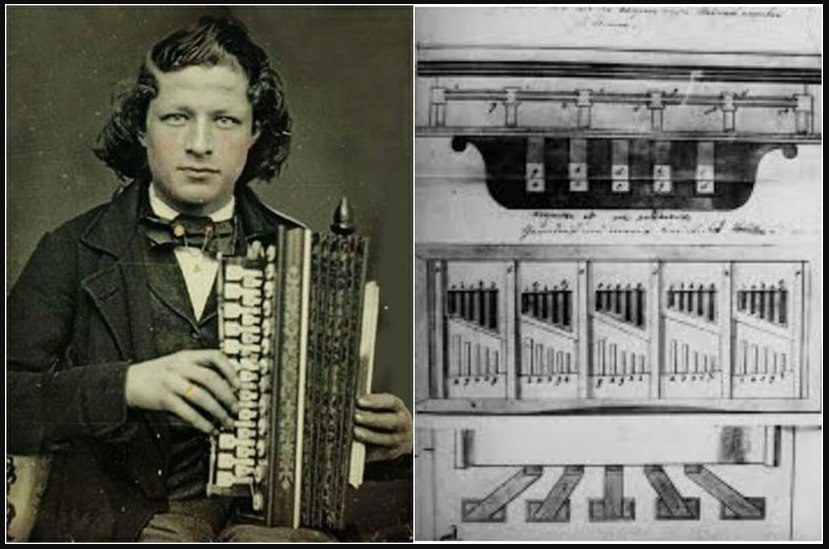
Cyrill Demian, his first accordion and the 1829 patent excerpt. Wikimedia Commons, CC BY-SA 4.0.
Kontra: the viola that refused to remain polite
The Transylvanian kontra is a modified three-string viola with an almost flat bridge, designed for fast rhythmic chords. University of Minnesota research describes a typical tuning around G — 196 Hz, D — 293.66 Hz, and a top string tuned to A — about 220 Hz.
It belongs to Roma, Romanian and Hungarian practices. Exactly the kind of instrument capable of ruining a nationalist conference simply by existing.

Three-string kontra with flat bridge. Photograph: Mami, Wikimedia Commons, CC BY 3.0.
The taraf: open source before technology invented modesty
A taraf is not an inventory of instruments.
It is distributed memory.
One player knows the opening. Another knows what the bride’s family expects. A child catches the harmonic formula before learning its name. An uncle shifts the key for the singer. A cousin notices when the dance floor is tiring.
Women work, perform, transmit repertoires and keep families functioning even though occupational histories long preferred to describe a line “from father to son.” A University of Bucharest study published in 2024 confirms the predominantly patrilineal transmission of the profession while insisting on women’s frequently ignored role.
It is not “anonymous folklore” because nobody created it.
It is anonymous because institutions found it easier to archive the tune than the chain of people who kept it alive.

Grigoraș Dinicu and his orchestra, 1920s. Unknown author, public domain, via Wikimedia Commons.
1949: the state hires the music and requests a clean shirt
In April 1949, the Folklore Institute created the Barbu Lăutaru Orchestra, modelled on the large Soviet ensembles. Its core included exceptional artists: Fănică Luca, Maria Lătărețu, Iliuță Rudăreanu and Damian Luca, followed by conductors and soloists such as Nicu Stănescu and Ionel Budișteanu.
In October 1953, it moved under the State Philharmonic “George Enescu.” One period programme preserved in museum research lists 17 pieces. The ensemble was professional, spectacular and perfectly able to represent Romania abroad.
Professionalisation came with a filter.
Documents speak of “raising the ideological and artistic level.” Translated from wooden bureaucratic prose: music had to be cleaned, arranged, disciplined and dressed as an acceptable national peasant.
Romani lăutari could be stars.
On the poster, they strategically became “Romanian folk artists.”
Communist Romania did not always remove them from the stage.
It removed them from the legend.

Maria Lătărețu aged eighteen, 1929. Unknown author, public domain in Romania, via Wikimedia Commons.
The Barbu Lăutaru Orchestra was dissolved in 1969.
Its aesthetic model lasted much longer.
Electrecord: four or five permissions a year
Electrecord, a state monopoly after nationalisation in 1948, became the almost exclusive gateway to Romanian records.
Research on Romani music under communism shows that the first cuts of lăutărească music in the 1960s could be hidden among selections of “authentic folklore.” Full albums appeared in the 1970s and 1980s, but the research identifies a ceiling of roughly four or five per year.
Not total prohibition.
Dosage.
Enough for the state to claim diversity.
Not enough for diversity to write its own rules.
In the 1980s, Speranța Rădulescu describes a virulent campaign to “de-pollute” folklore, initiated by Party bodies and promoted by intellectuals obedient to the regime. “Pollution” is a remarkably honest word.
It tells us exactly what the system thought of life when life wore the wrong shoes.
Mixed, urban, Roma, mahalle or overly contemporary music had to be separated from the pure image.
Purity, as usual, was manufactured in an office.
Credit is not a property certificate
Let us be clear about what I am not saying.
Not every doina is “Roma.” Not every taraf had the same ethnic composition. Romanian traditions cannot all be reduced to lăutari. And there is no one-way cultural pipe from a source community to a beneficiary community. Romanians, Roma, Hungarians, Jews, Greeks, Turks, Serbs and others lived, performed, negotiated and copied one another long before the internet invented the copyright scandal.
Credit means something else:
- naming musicians when names survive;
- not erasing Roma identity exactly when an artist becomes a national symbol;
- recognising family transmission and wedding labour as cultural infrastructure;
- separating composer, performer, arranger, collector and institution;
- not confusing the state archive with the author of culture.
Heritage without metadata is simply an elegant form of amnesia.
Cruel Sitges: if you borrow, put the ingredients on the menu
The connection to Cruel Sitges is not an SEO sticker pasted onto the ending.
It is in the musical material.
In “Jeux Cruel en Sitges”, the track moves at 250 BPM and declares its timbral sources without the modesty of pure folklore: incandescent cimbalom, runaway tárogató, obsessive kontra bass and accordion drones. The Balkan instruments do not decorate the electronic machine.
They drive it.
I do not claim museum reconstruction. I do not put an embroidered blouse in a glass case and call it authenticity. I take timbres with mixed biographies — Budapest, Vienna, Banat, Transylvania, Roma weddings, state orchestras, the club — and let them soil one another again.
That is the honest form of influence for me.
Not purity.
Traceability.
Not “Romanian essence.”
Names, routes, instruments and transformation.
If you are going to steal fire, at least do not claim you were born holding the lighter.

Taraf de Haïdouks in concert, Galicia, 2008. Photograph: Estevoaei, Wikimedia Commons, CC BY-SA 3.0. Continuity does not stay in the display case. It goes on tour.
The state signed. The musicians paid for the ink.
Romanian folklore is not false.
It is more truthful than the official story told about it.
Its truth has room for slavery and emancipation, Paris in 1889 and the orchestra of 1949, the Viennese patent of 1829 and the Budapest pedal of 1874, the wedding, the mahalle, radio, record, stage and the club at 250 BPM.
It has room for Romanians.
It has room for Roma.
It has room for people whom music’s passport names differently from one era to another.
The problem is not that the state turned this music into heritage. Institutions sometimes preserve what the market would destroy.
The problem is that heritage was presented as though it had composed itself, anonymously, one misty morning beside a highly photogenic village well.
No.
It had professionals. Families. Slaves. Stars. Filters, censors, technicians, directors and people who played until everyone else forgot how much work sits behind something called “natural.”
The lăutari do not need a charitable footnote.
They need accurate credit.
Not because history should be polite.
Because without them, the credits lie.
Principal research: Council of Europe — Roma slavery in Wallachia and Moldavia, RomArchive — Roma slave jesters and lăutari, Oxford Handbook — Romanian oral traditions of professional Romani musicians, Speranța Rădulescu — Music, State and Society, University of Bucharest — From father to son, MDW — The tárogató in Romania, City of Vienna archive — accordion history, and research on the Barbu Lăutaru Orchestra in Revista de Etnografie și Folclor. The cover is an editorial collage made exclusively from the three real photographs reproduced in the article; the archival photographs are public domain and the collage preserves their documentary material.