Paradise has a human-resources problem.
Everyone arrives young.
Nobody asks who will change the light bulb when you are 78.
Sitges knows how to seduce you impeccably. It offers the Mediterranean, a church theatrically poised on a promontory, palm trees that appear to have unionised with holiday photography, and a street where sin has now received cultural status. The town knows what to do with your desire at two in the morning.
The less photogenic question is what it does with your fragility at two in the afternoon.
With the man who came here in 1987 for one week and stayed for forty years. With the woman who built a chosen family and then buried part of it. With the trans person who fought a lifetime for a name and does not want an admission form to confiscate it. With the British, French, Romanian or Dutch migrant who speaks the local language of flirting better than the language of social care.
Sitges became famous because it allowed queer people to be seen.
Now it must prove it can still see them when they are no longer poster material.
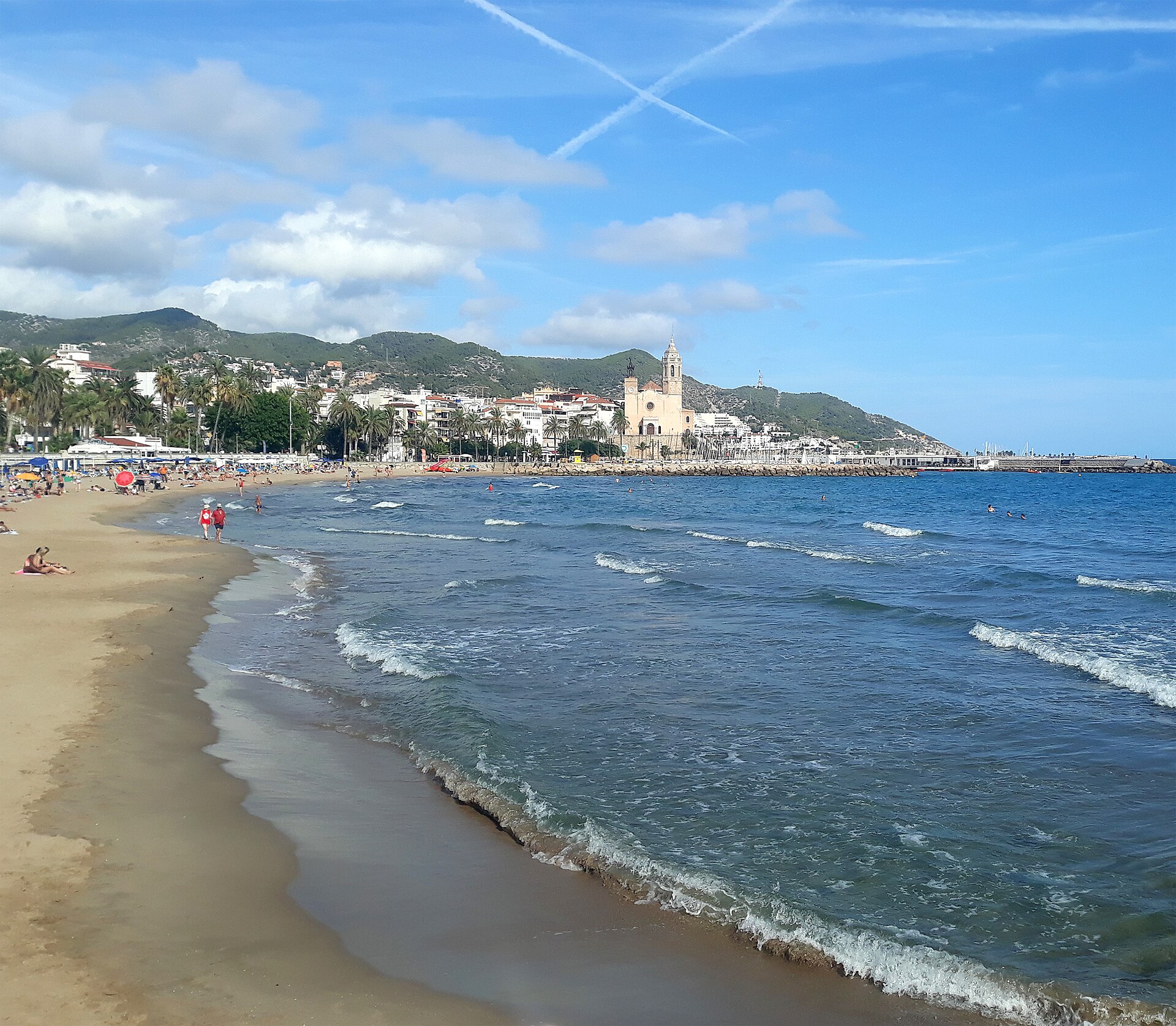
Sitges, its beach and church seen from the sea. Photograph: acediscovery, Wikimedia Commons, CC BY 4.0. Paradise looks excellent from a distance; care policy begins when you enlarge the picture.
The town is no longer young. Only its advertising is.
In 2025, Sitges had 32,690 residents in the official Idescat series. Of these, 8,979, or 27.47%, were foreign citizens. The town hall displays a close official annual figure of 32,609 and a larger continuous register of 34,828; the difference comes from method and update date, not from a demographic miracle produced by sangria.
The numbers that matter here concern age. In 2021, people aged 65 and above represented 18.92% of the town. By 2025, the share had reached 20.12%. Applied to Idescat's 2025 population, that is roughly 6,578 people.
The ageing index — the ratio between the older and young populations — rose from 142.4 to 162.5 in only four years. In other words, for every 100 children and teenagers under 16, Sitges had about 163 people aged 65 or over. Idescat does not ask sexual orientation, so we do not know how many of them are LGBT. Applying a pop-cultural percentage to the population and calling it precision would be fraudulent.
But we know two things.
Sitges is ageing.
And for decades it has attracted queer people who came not only as tourists but as residents, workers, entrepreneurs, artists, retirees and survivors.
The data still lacks a column for their story. Their bodies do not.

Sitges Pride 2019. Photograph: Mike McBey, Wikimedia Commons, CC BY 2.0. Pride counts its audience very well; life after Pride is documented much less efficiently.
The generation that came for freedom stayed for life
For a European gay man in his twenties or thirties during the 1970s or 1980s, Sitges was not merely beautiful. It was practical.
You could walk with a different choreography of the body. You could enter a bar without inventing a girlfriend. You could dance, flirt, refuse, exaggerate, wear an impossible costume and meet people who did not demand an explanatory appendix to your identity.
Such freedoms look ordinary only after they have been won.
In Spain, homosexuality endured Francoist repression, including a 1954 amendment that placed homosexual people within the Ley de Vagos y Maleantes, followed by the Ley de Peligrosidad y Rehabilitación Social of 1970. Barcelona's first modern LGBT-rights demonstration came in 1977. Homosexuality was removed fully from the dangerousness law in 1979. Same-sex marriage became legal in 2005.
A person who is 75 today was 28 in 1979.
He was not reading history.
He was crossing it with his own body.
Many were pioneers without salaries or titles. They shifted the social centre of the town, filled bars, created businesses, organised carnival nights, paid rents, taxes and bills extravagant enough for the local economy to learn applied tolerance quickly.
Now that same generation is entering an age when freedom no longer means only admission to a club.
It means access to a doctor, a lift, transport, housing, care and a person who notices that you have not answered the phone.
Chosen family is family. The state just occasionally asks for a certificate.
Much of modern queer life was built through chosen families: friends, former lovers, neighbours, fellow activists, bar owners, drag queens, people met on a beach and kept for thirty years.
Those networks have been extraordinary.
And vulnerable.
They do not always have medical decision-making rights. They may no longer live in the same town. They are not necessarily present on a form offering two boxes: spouse and relative. Some were decimated by AIDS. Others thinned through migration, retirement, illness and housing costs.
For LGBT people without children or good relationships with biological family, losing a friend can mean more than grief. It can mean losing the driver, translator, emergency contact, key holder and only witness to an entire life.
Heterosexual society calls all this an “informal support network”.
We called him Paco.
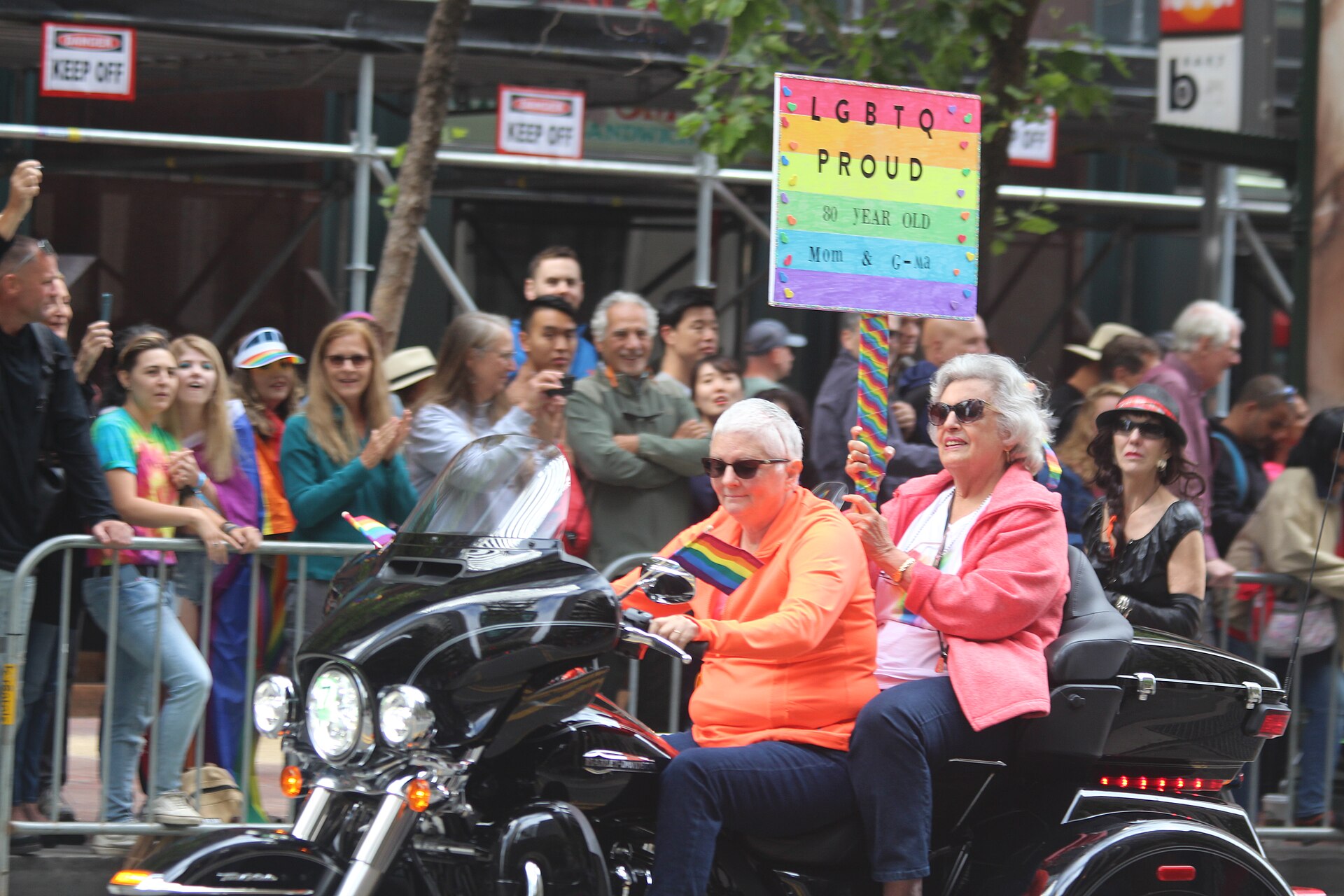
“LGBTQ Proud”, San Francisco Pride 2019. Photograph: Quinn Dombrowski, Wikimedia Commons, CC BY-SA 2.0. The photograph is not from Sitges; it is a very effective answer to the idea that visibility has an expiry date.
Loneliness is not a poetic metaphor. It is a risk factor.
In 2025, the World Health Organization estimated that approximately one in six people worldwide experiences loneliness. Among older adults, about one in ten experiences loneliness and roughly one in four is socially isolated. The WHO Commission on Social Connection associated loneliness with more than 871,000 deaths a year between 2014 and 2019 — about 100 every hour — and with increased risks of cardiovascular disease, stroke, diabetes, cognitive decline, depression and premature death.
For older LGBT people, the general layer of ageing sits beneath several others: discrimination, accumulated grief, absence of children, distance from biological family, migration, mistrust of services and the possibility that their own community worships youth with almost religious discipline.
Spain's 26 de Diciembre Foundation published Tolerancia 0. Las violencias sufridas por las personas mayores LGTBIQ+, research based on 730 online questionnaires — 226 from older LGBT respondents and 504 from the general population — plus 17 interviews and 3 focus groups.
It is not a perfectly representative national statistic and should be read with that limitation. But its findings are too coherent to be treated as decoration:
52.2% of older LGBT respondents reported discrimination in the previous five years, compared with 34% of the majority group.
69% reported mood problems or stress linked to discrimination, compared with 58%.
47% reported loneliness, compared with 29.8%.
41.7% feared being lonely in the future, compared with 33.7%.
These numbers do not say that every gay senior in Sitges is alone.
They say a town that lives economically from the community cannot morally afford to discover the answer too late.
The most expensive closet may be a room in residential care
One fear recurs throughout research about LGBT seniors: returning to the closet when dependency begins.
Not because identity disappears, but because power changes hands.
Suddenly, someone else controls your medication, shower, clothes, visitors and key. Your roommate may be the person who insulted you forty years ago. A carer may assume the photograph beside your bed shows “a good friend”. An intake form may define sex in ways that erase a trans identity. Staff may be well meaning and utterly unprepared — the classic combination through which discrimination acquires a polite name badge.
In the 26D Foundation study, 52.6% of older LGBT participants rejected traditional residential models. Reported reasons included cost, staff shortages, fear of discrimination and loss of identity.
Catalonia's Law 13/2025, published in 2026, explicitly obliges social services and care centres for older people, public and private, to prevent discrimination against LGBT residents. Article 53 requires local authorities to include an LGBT perspective in planning and direct care and to consider vulnerability, dependency, institutionalisation, social isolation and unwanted loneliness.
The law matters.
But no legal article walks into the night shift by itself.
For that, you need training, procedures, enough staff and a culture in which a partner does not have to introduce himself as a cousin every time.

Members of The Golden Gays, Manila Pride 2016. Photograph: Pndbnt, Wikimedia Commons, CC BY-SA 4.0. This is not Sitges. The gesture is universal: community sometimes starts with someone fixing your necklace.
September 2023: No Más Armarios starts with the small things that keep a person alive
The most interesting local answer in Sitges is not a luxury residence with a rainbow logo and a tariff that immediately creates another kind of loneliness.
It is a community programme.
In September 2023, Colors Sitges Link launched No Más Armarios / No Més Armaris, aimed at LGBT people over 65 and co-funded by the “la Caixa” Foundation. The programme operates in Sitges but welcomes participants from Garraf and elsewhere in Catalonia.
What does it do?
Outrageously simple things.
Walks along the promenade, Mondays at ten.
Qi Gong on Wednesdays.
Breakfasts, board games, film forums, cultural outings and workshops on grief, sexuality, computing and wellbeing.
Social, psychological and legal support.
Home accompaniment.
An intergenerational therapeutic garden.
In a presentation published in the association's magazine, the programme reported directly accompanying around a dozen people experiencing loneliness, limited mobility or chronic illness, while more than 15 people took part in activities. Numerically, this is not a national system.
Humanly, it can be the difference between a week in which nobody says your name and one in which someone is waiting for you to walk.
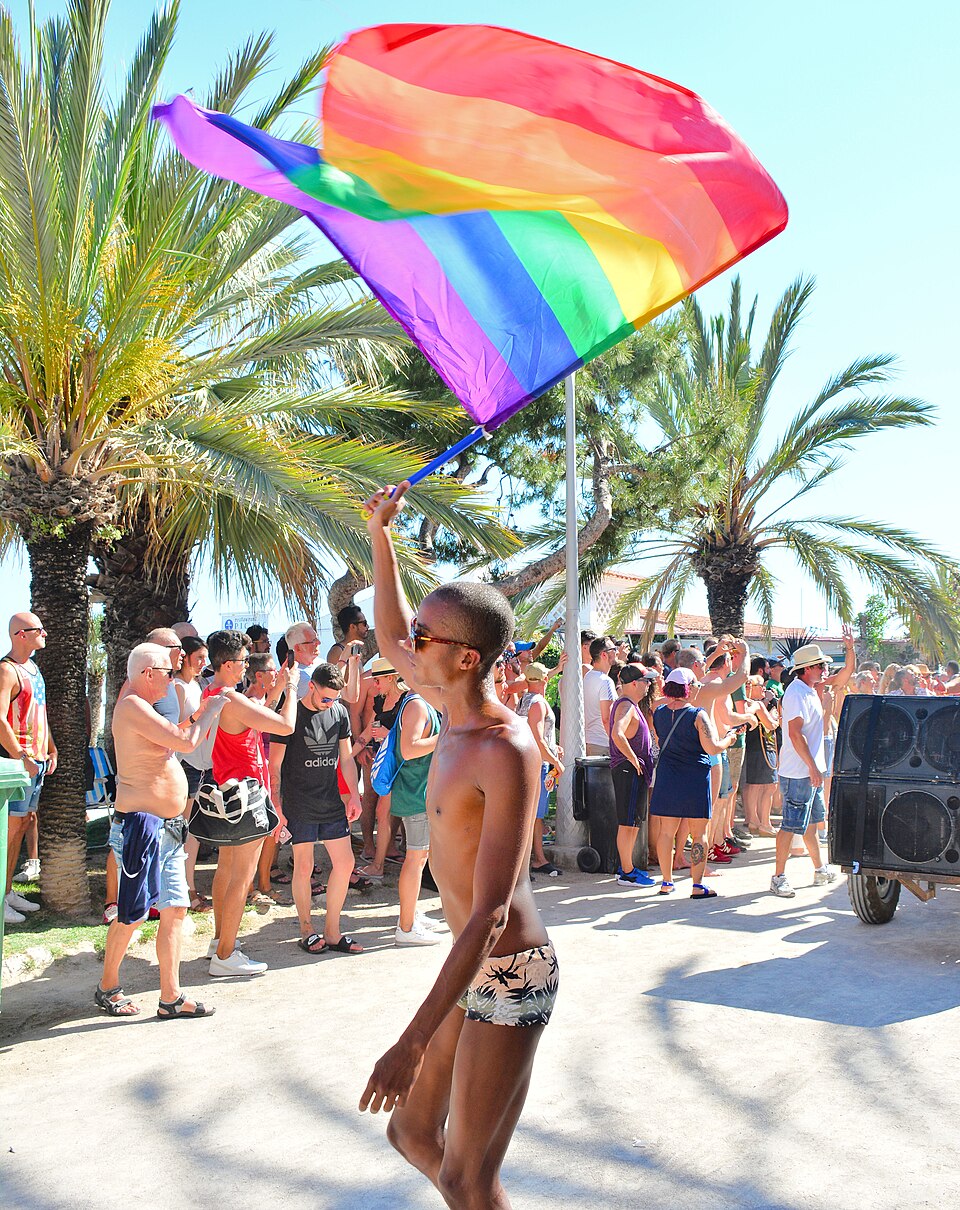
Sitges Pride 2017. Photograph: Mike McBey, Wikimedia Commons, CC BY 2.0. The flag announces freedom. The social programme checks whether anyone has eaten.
Why a Monday walk can be more political than a Saturday speech
No Más Armarios treats social connection as infrastructure, not an ornamental bonus. Here the project almost perfectly matches WHO recommendations: community groups, meaningful activities, volunteering, movement, access to public space and befriending interventions can reduce isolation and depressive symptoms.
But the programme also does something specifically queer.
It does not ask a participant to translate a life into an acceptable heterosexual version.
You can speak about a dead boyfriend without correcting the pronouns.
You can discuss sexuality at 72 without your listener looking as though you brought a vibrator to the budget meeting.
You can say that you have no children, that your family lives abroad, that your former partner is your emergency contact and that a bar once served as a community centre with an alcohol licence.
A universal service becomes equal only when it understands different biographies.
Otherwise it offers everyone the same door and wonders why some people do not have the key.
Las Magnolias, or the moment theory enters the care home
In October 2024, Colors Sitges Link met staff from the Las Magnolias residence to connect the programme with older LGBT people who lacked stable support networks. The association explicitly described the risk of LGBT residents going back into the closet and its objective of creating emotional companionship and social connections.
In 2024 the project also organised training for professionals in care services and institutions, including a seminar at Casa Olivella in Vilanova i la Geltrú led by clinical psychologist Juan Carlos Uríszar. In September 2024, Sitges hosted the first International Congress on Older LGTBIQ+ People, co-organised with the 26 de Diciembre Foundation. Participants included Prado García Velázquez, who leads No Más Armarios, and Josep Maria Mesquida, president of the Enllaç Foundation.
These meetings do not have Pride's glamour.
They possess something rarer: continuity.
By 2026, collaboration with Las Magnolias included shared relaxation and intuitive-painting activities involving residents, carers and volunteers. Marketing would call this “inter-institutional impact”.
I would call it something simpler.
Someone entered the building before the closet door closed.
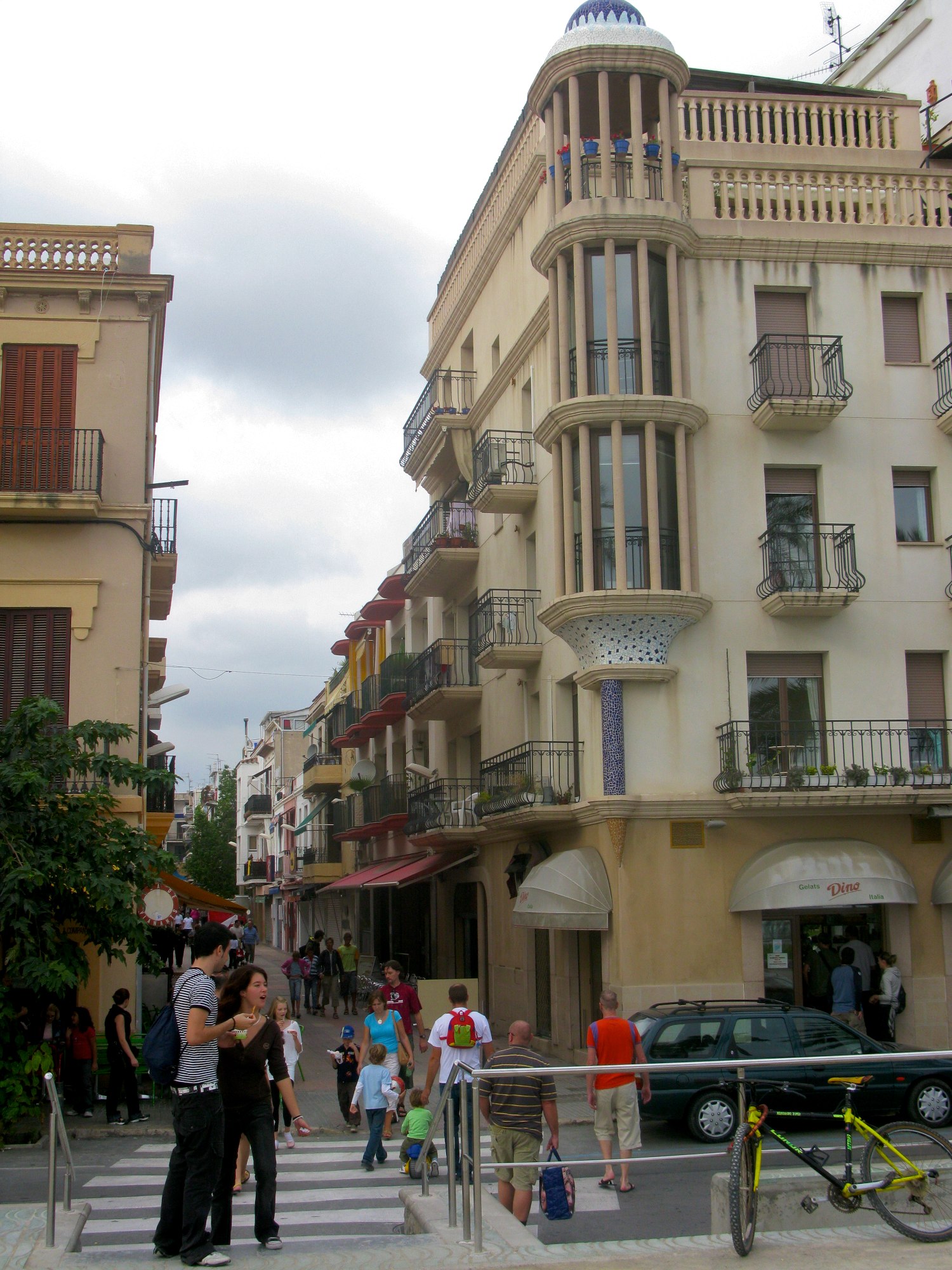
Carrer Primer de Maig, Sin Street and its cultural history. Photograph: Alain Rouiller, Wikimedia Commons, CC BY-SA 2.0. For many people, the bar was the first social service that did not ask them to lie.
An international town grows old in several languages
More than a quarter of Sitges residents are foreign citizens. In 2025, Idescat counted 789 foreign residents aged 65 and above: 342 aged 65–69, 274 aged 70–74, 173 aged 75–79, 113 aged 80–84 and 73 aged 85+. These are foreign citizens, not everyone born abroad who later naturalised.
The data does not say how many are LGBT.
It does show that local care must understand later-life migration. A person may be entirely independent in English and completely lost inside a medical procedure in Catalan. They may have a pension in one country, insurance in another, biological family 1,800 kilometres away and chosen family two streets away. They may be connected to community in summer and isolated in February.
Paradise has paperwork.
And the paperwork rarely comes with subtitles.
No Más Armarios offers precisely the human interface systems forget: someone who knows that a biography does not fit inside a drop-down menu.
Housing costs may evict the town's own memory
Care is not only medical services. It means being able to remain where your relationships, doctor, café, route and neighbours are.
Sitges lives from attractiveness, and attractiveness has the indecent habit of raising the price per square metre. Tourism, seasonal housing, investment property and international demand can make the town excellent to visit and difficult to inhabit on a modest pension.
For a queer senior, forced relocation is more than an address change. It can mean losing identity infrastructure built over decades. Move to a cheaper town and you may lose the pharmacy that knows you, the friend on the corner, the association, the step-free route and the place where you do not need to explain yourself.
The town then risks a deliciously cruel paradox:
Selling, at a very high price, the image of freedom built by people it can no longer afford to house.
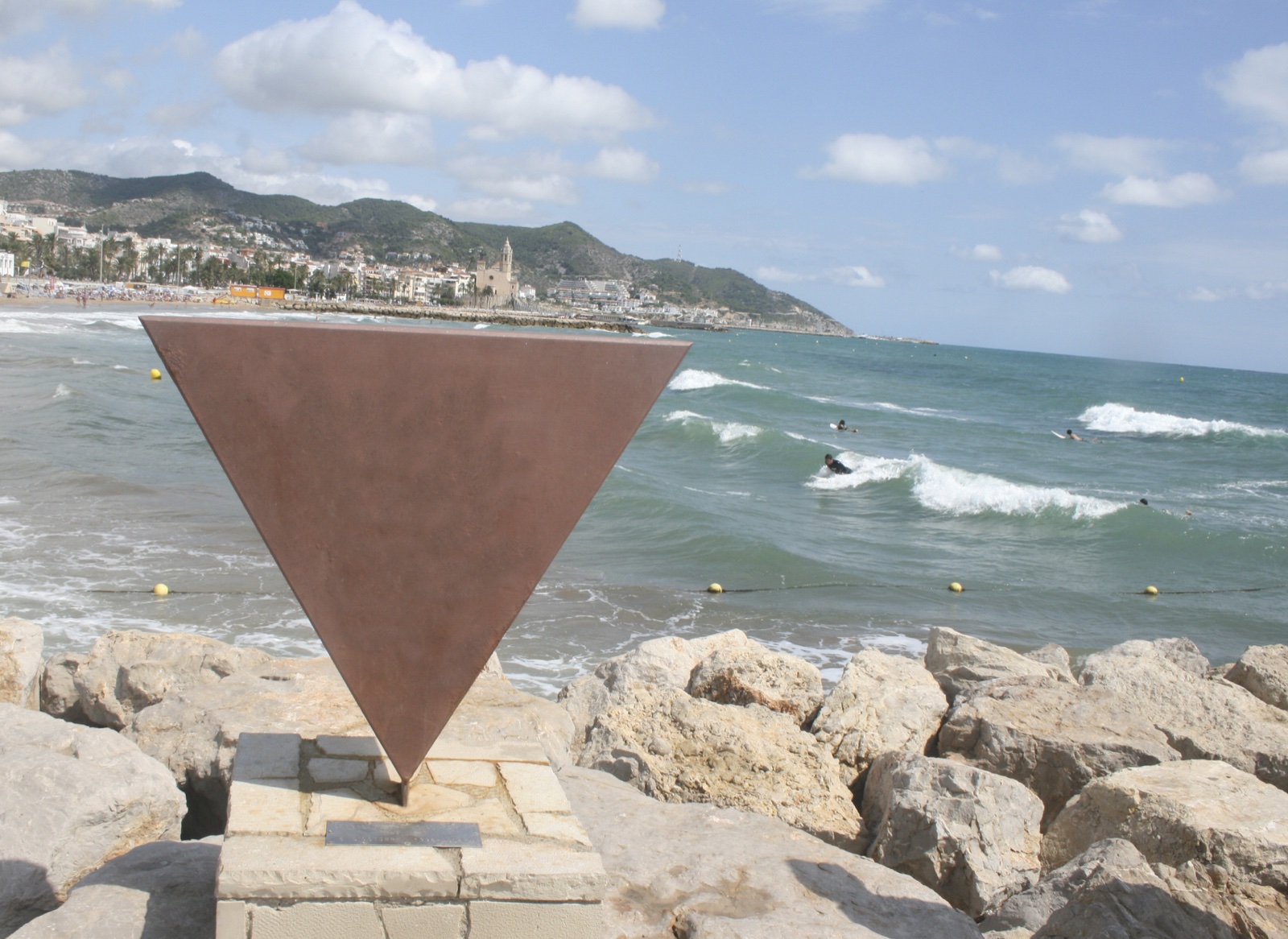
The monument against homophobia in Sitges. Photograph: BoBink, Wikimedia Commons, CC BY-SA 3.0. Public memory is useful. Affordable rent is even more persuasive.
The queer community has an age problem too. Let us not blame only the state.
It would be convenient to say the administration must fix everything while we continue the party with perfectly waxed consciences.
But gay male culture has sometimes built youth as currency, the body as résumé and age as a software error. Apps sort. Clubs segment. Advertising selects. A 68-year-old man can live in a “gay paradise” and still become invisible to his own community long before the care system sees him.
Older lesbians, trans people, bisexuals and queer seniors with disabilities may be even less visible inside a tourism brand centred on the mobile, consuming gay man who is still photogenic during golden hour.
Ageism does not become progressive because it wears a rainbow tank top.
WHO estimates that one in two people worldwide holds ageist attitudes toward older adults. In queer communities, ageism can combine with racism, sexism, transphobia, classism and ableism. We do not receive an automatic moral exemption because we have been discriminated against. Sometimes wounded people learn empathy.
At other times, they learn door policy.
What a paradise caring for its pioneers would look like
Sitges does not need to become a sanatorium with flags. It needs to treat ageing as part of queer city life, not an exit from it.
That means:
Real mapping. Anonymised data about needs, language, housing, disability, loneliness and access to services, without an intrusive census of orientation.
Mandatory training. Not a webinar forgotten in a folder, but evaluated LGBT competence in residential care, home care, health and social services.
Multilingual navigation. People able to translate not only words but the system.
Regular companionship and checking in. Home visits, calls, well-coordinated volunteers and action when someone disappears from their routine.
Affordable housing. Protection from displacement and inclusive assisted-living options without compulsory segregation.
Intergenerational spaces. Not “elderly day” in a separate room, but activities through which memory travels between ages.
Recognition of chosen family. Forms and protocols that allow people to decide who counts as family and who may be contacted.
Sexuality and intimacy. The right to desire does not expire when a walking stick appears. Dignified care includes intimacy, prevention and respect, not infantilisation.
And above all, stable funding.
Volunteers are magnificent.
But they must not become the cheap alibi of an expensive town.

Sitges Carnival, 2022. Photograph: Pitxiquin, Wikimedia Commons, CC BY-SA 4.0. The community knows how to organise spectacle. It can organise continuity too.
Cruel Sitges and what remains after the song
The universe of Cruel Sitges lives inside the tension between the town's seduction and its cruelty, between the night that promises you everything and the morning that presents the bill.
Ageing may be the least comfortable version of that tension.
The album can preserve the light, street, flesh, excess and melancholy. But a town is not truly queer merely because it offers an excellent backdrop for desire. It is queer when it refuses to abandon the body after the desire industry loses interest.
Night creates memory.
Care allows it to survive.
That is the authentic connection: not pasting a soundtrack over a social problem, but recognising that the people who made the atmosphere possible matter more than the atmosphere.

Sitges at dusk. Photograph: EvelynMwangi, Wikimedia Commons, CC BY-SA 4.0. Sunset is democratic. The photograph especially. Access to care is still working on it.
Paradise is measured at 78, not 28
Sitges cannot be accused because people grow old.
That would be an ambitious lawsuit even for branding.
It should, however, be judged by the quality of its response. It already has an association that understood the issue, a programme launched in 2023, collaborations with residences and professionals, concrete activities and a Catalan law more explicit than before. These are reasons for hope.
They are not reasons for complacency.
A dozen people accompanied is a beginning, not coverage. One seminar is an opening, not a system. A monument is memory, not care. Pride is visibility, not a home visit.
The town that sold queer freedom to the world now has the chance to invent a mature version of the product.
Without beige packaging.
Without hiding the walking stick.
Without asking pioneers to go back into the closet so that their soup arrives on time.
They came for the beach.
They stayed for freedom.
They built the community.
Now the community must stay for them.
Because a gay paradise is not measured by how well it seduces you at 28.
It is measured by who knocks on your door at 78.
Sources consulted
- Sitges Town Council — population data
- Idescat — age structure, ageing and dependency in Sitges
- Idescat — total and foreign population of Sitges
- Colors Sitges Link — No Más Armarios programme
- Colors Sitges Link — collaboration with Las Magnolias residence
- Colors Sitges Link — training for care professionals
- Colors Sitges Link — first international congress on older LGTBIQ+ people
- Fundación 26 de Diciembre — Tolerancia 0
- WHO — From loneliness to social connection, 2025
- FRA — LGBTIQ equality at a crossroads, EU Survey III
- BOE — Catalan Law 13/2025 on the rights of LGBTI people