Before Grindr, your profile did not have six photos.
It had no age, height, weight, tribe, position, status, private album or sentence beginning with “no drama” before delivering precisely the drama.
Your profile was your walk.
The speed at which you slowed down.
The fact that you passed once and then again, with the transparent elegance of a man pretending to be lost on a perfectly straight path.
And, above all, the way you turned your head.
Not too far. Desperation has never been a premium filter.
Just enough to say: I saw you. You saw me. We can continue the negotiation without giving the archive more material than it deserves.
It was technology.
It simply had to be worn on the body.
The body already had an interface
Cruising is often described as a world without rules, which says more about the observer’s inability to read those rules than about their absence.
In reality, cruising spaces operated through local protocols: repeated routes, pauses, glances, the position of the body, distance maintained and proximity accepted. None of these formed a universal dictionary. A gesture in Montjuïc did not automatically mean the same thing in a London toilet, on a New York pier or in woodland outside Sitges.
Anthropologist José Antonio Langarita documented this grammar in Montjuïc Park, on Gavà beach and on the beach and in the woodland of Sitges. His 2014 dissertation describes men slowing down, returning, holding a gaze and learning the system by watching others.
There was no onboarding.
No window appeared asking you to “accept cookies.”
Although, in retrospect, perhaps there should have been.
The police were among our earliest UX researchers
Much of cruising history survives not because participants archived their nights, but because the police archived them on their behalf.
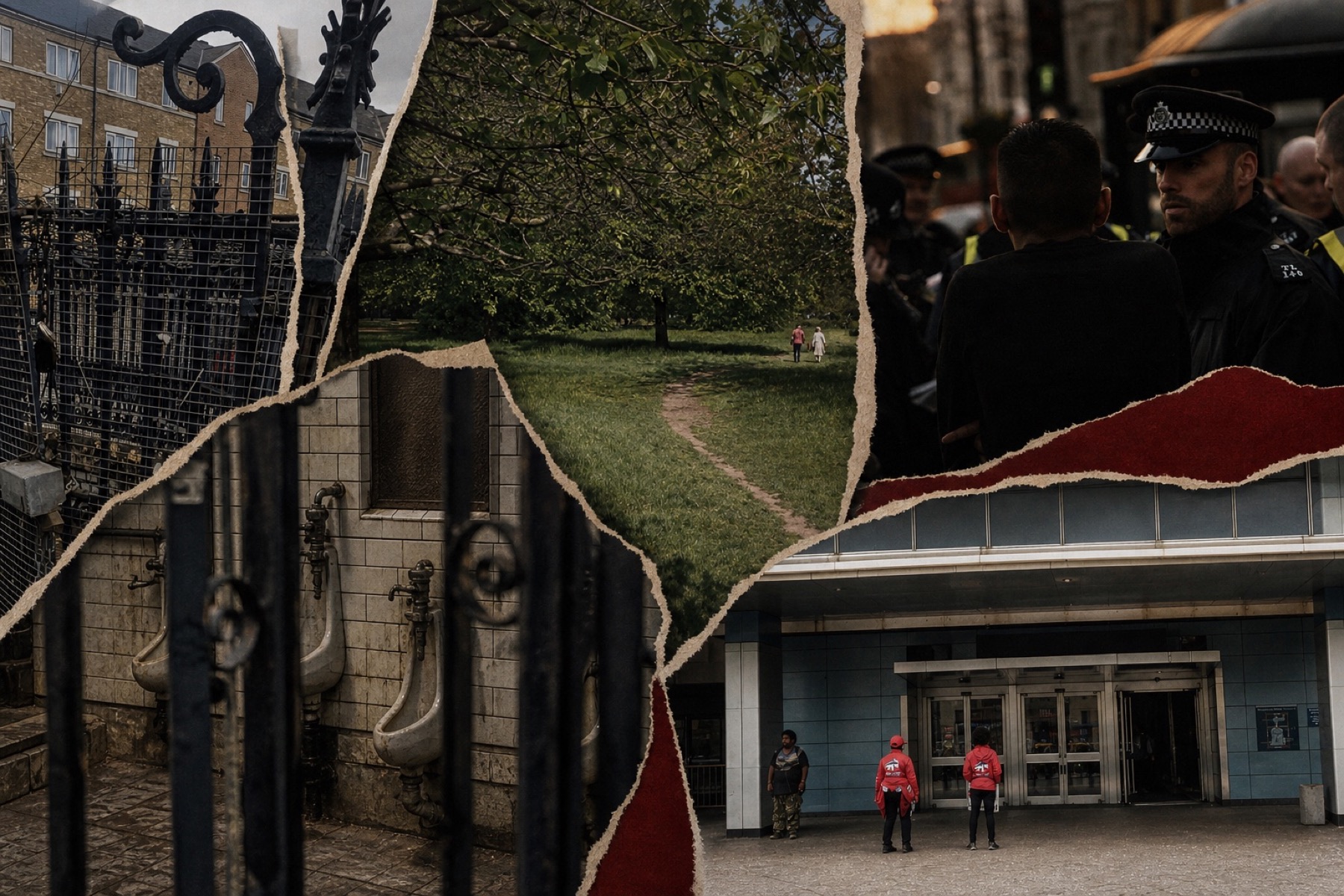
In September 1932, two plain-clothes officers watched a public toilet on Popes Road in Brixton. To see through a decorative opening, they climbed onto the base of a lamppost roughly seven inches high. One of them slipped.
Repression, it must be admitted, was not always entirely free of slapstick.
The file preserved by The National Archives nevertheless reveals the serious stakes: plain-clothes officers, building plans, photographs, surveillance and the interpretation of an ordinary gesture as possible evidence.
The state did not invent cruising.
But it participated actively in its design.
When you are watched, the code becomes more discreet. When discretion increases, insiders become more important. When insiders recognise one another, the space produces a community that the law pretends merely to discover.
It is one of authority’s favourite ironies: it creates the conditions for secrecy, then declares itself shocked that the secret exists.

A path in Montjuïc Park, 1922. Photograph: Jaume Biosca i Juvé, Wikimedia Commons, public domain. Historical image used for context; it does not depict cruising participants.
The park knew how to scroll before the phone did
A good cruising ground combined two apparently incompatible things: public access and pockets of intimacy.
A visible entrance.
A path that allowed you to return.
Vegetation, bends, cubicles, ruins, darkness, foot traffic and an exit fast enough to keep denial plausible.
In Langarita’s research, the entrance works as a zone of visibility and negotiation, while more concealed areas take over what follows. Walking is not merely transport. It is a message.
In practice, users scrolled with their entire bodies.
The battery simply lasted longer.
And if you did not like the profile, you did not have to claim that the app “wasn’t sending notifications.” You kept walking.
A glance was not consent to everything
Nostalgia has a bad habit of perfuming danger.
Body codes could protect anonymity and allow refusal without biography. They could also create ambiguity, pressure or misinterpretation.
A sustained glance could mean interest.
It did not mean agreement to every act.
Returning could open a negotiation.
It did not conclude it.
This matters because the myth of “pure” cruising before technology complicated everything is both seductive and false. Analogue spaces offered freedom, but also police, robbery, violence, shame, racism, fetishisation, illness and class hierarchies.
We did not lose paradise.
We changed the infrastructure of risk.
Then, on 25 March 2009, proximity gets a logo
Grindr arrived on the iPhone at an almost indecently convenient technological moment: GPS, the App Store and a phone you could carry everywhere.
The product question was simple and devastatingly effective:
Who is gay and nearby?
The answer no longer required the right path, the right hour or an ability to decode half a second of eye contact.
It required a signal.
Before, you had to enter a space to see who was there.
Now the space entered your pocket with you.

iPhone 3G. Photograph: Feureau, Wikimedia Commons, CC BY-SA 3.0. Contextual image; the screen is not displaying Grindr.
Grindr did not invent proximity. It changed the order of operations.
That is the essential difference.
Analogue cruising often began with the body and offered very little biography.
You saw him.
Perhaps you wanted him.
Only later did you learn — if either of you did — his name, exact age, profession or story.
The app reverses the sequence.
First comes the profile: photograph, distance, labels, preferences, text and sometimes an inventory of everything the person claims not to tolerate.
Only then comes the body.
A study of Grindr and gay space observed as early as 2013 that the app does not simply break with the past. It reuses the cues, codes and symbols of pre-Stonewall cruising while detaching them from the compulsory geography of the gay village.
In other words, the app did not demolish the park.
It made the park portable.
Once there is a profile, there is also a procurement department
The analogue body transmitted little data.
The platform prefers a more generous conversation.
Age.
Height.
Weight.
Location.
Photographs.
Interests.
Conversations.
The time you log in.
Who makes you stop.
Who makes you pay.
Information brings real advantages. You can negotiate boundaries, avoid situations, find community in a city with no gay bar and say what you want without turning an eyebrow into an operating system.
But information leaves traces.
In 2025, the Borgarting Court of Appeal upheld a NOK 65 million fine against Grindr. The Norwegian Data Protection Authority stressed that the mere fact of being a user of the app can constitute special-category data about sexual orientation or sex life.
In the park, a stranger might remember you.
On the platform, the advertising ecosystem can remember you too.
It is more efficient.
Not necessarily more romantic.
Anonymity used to mean knowing less. Now it means hoping the data knows how to stay quiet.
Langarita uses a beautiful idea: “interested unknowing.”
Participants did not ask everything. Sometimes they did not acknowledge each other outside the place. Silence was not an absence of information, but a pact.
The platform offers another model.
Safety appears to come from more knowledge: a photograph, verification, chat history, distance, video call.
Sometimes it does.
At other times, all of those elements become material for screenshots, outing, extortion or the police.
In 2023, Human Rights Watch documented the use of fake profiles, photographs and conversations for entrapment and abuse against LGBT people in several countries in the Middle East and North Africa.
Danger did not simply become digital.
The digital acquired a physical address.
The app is now trying to recreate exactly what it replaced
In 2025, Grindr expanded its “Right Now” feature globally. A post stays active for one hour. The message is simple: I am here, I want it now, the window is closing.
Brief presence.
Local availability.
Signalled intention.
Disappearance.
Congratulations.
We have reinvented the man who waits for a while at the edge of the path and then leaves.
The official description of the feature promises less filtering and less pointless conversation. The market spent years turning desire into a form, then discovered that users still appreciate urgency.
The history of technology is full of innovations that end up recreating a bench, a key, a room or a man turning his head.
Only with a subscription.
Sitges: where the gaze also comes with a sea view
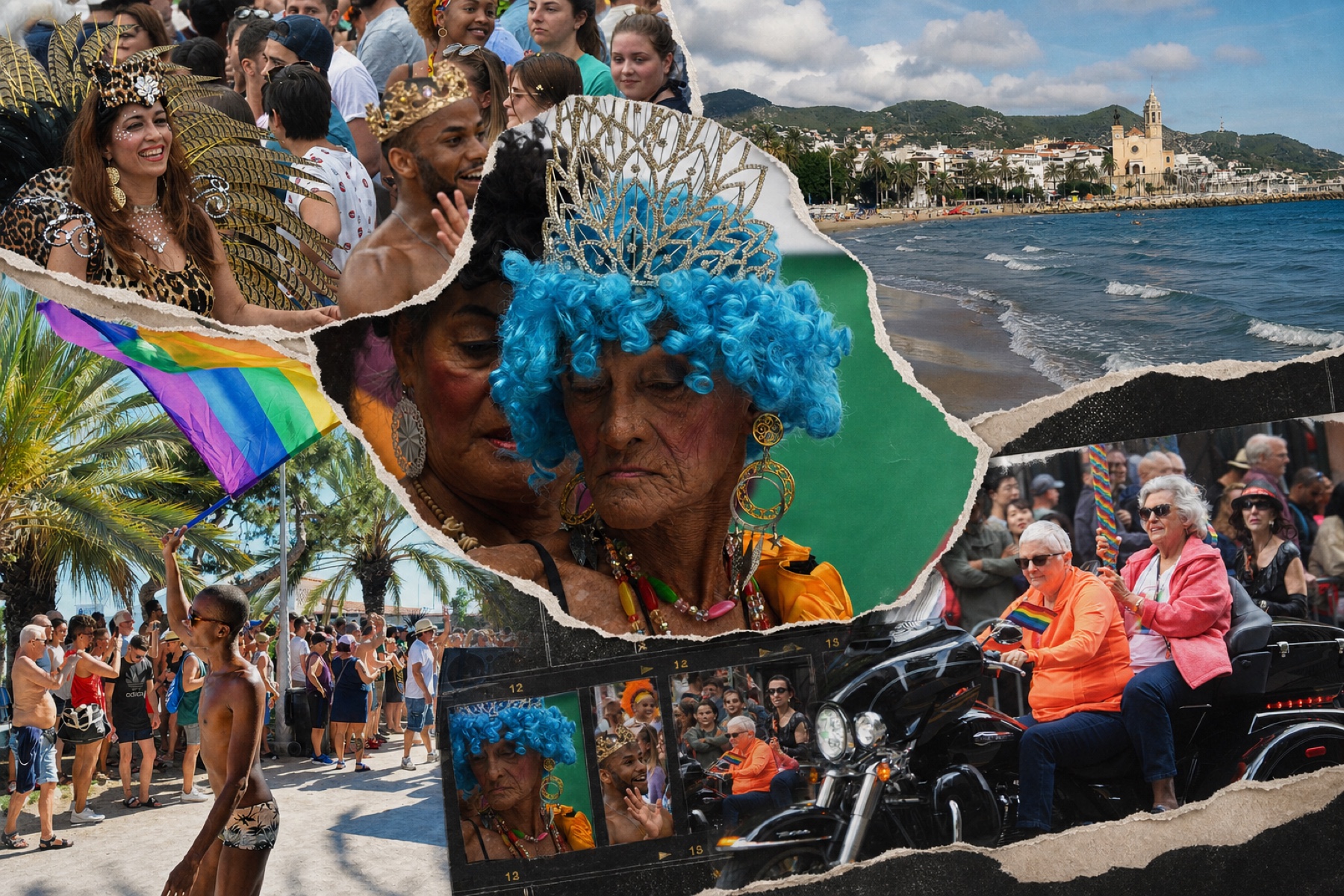
Sitges appears in Langarita’s research not as metaphor but as an actual field site: beach, woodland, route, access, retreat and a geography in which tourism complicates identity.
A holiday town offers something the app understands very well: proximity without complete biography.
You can be near without being from here.
You can be visible without being known.
For a few hours, you can become the version of yourself with better marketing.

Sitges beach, 2005. Photograph: Niklas Gustavsson, Wikimedia Commons, CC BY 2.0. Contextual image; the people photographed are not identified as cruising participants.
The Cruel Sitges universe lives precisely in this crack between seduction and trace.
The sea promises to erase.
The phone keeps.
The night offers you an alter ego.
Morning sends it a notification.
The connection is not that every glance in Sitges is cruising. That would be foolish, and the town already has enough creative tour guides.
The connection is that desire needs infrastructure: a path, a beach, a hotel, an app, a door, a signal. Infrastructure decides who sees, who enters, who pays and what remains afterwards.
We did not move from freedom to technology. We moved from one kind of memory to another.
Analogue cruising could disappear with the man leaving the park.
Not completely. Witnesses, police, violence, gossip and memory remained.
But the archive was fragmentary.
Digital cruising often begins with the archive already open.
The profile exists before the meeting.
The chat exists before the touch.
The distance exists before the introduction.
And the screenshot can exist after everything is over.
This does not mean that the past was better or the present worse.
It means that power has been redistributed.
Before, you had to read the room.
Now the room reads you.
The profile did not replace the turn of the head
Even after all the fields, filters and photographs, the real meeting preserves one moment that cannot be outsourced.
He arrives.
You see him.
He sees you.
And both of you decide whether the data told the truth.
The body returns to the conversation with its usual disrespect for metadata.
This is where Grindr stops and the old protocol starts again.
A glance.
A hesitation.
One step.
Perhaps another.
Before Grindr, your profile was the way you turned your head.
After Grindr, that is still where the verdict is delivered.
Except now, before you turn your head, someone has accepted the terms and conditions.
Principal sources: José Antonio Langarita — Intercambio sexual anónimo en espacios públicos, The National Archives — Policing sex in public toilets in 1930s London, First Monday — The Rainbow Flag and the Green Carnation, Human Rights Watch — Digital Targeting and Its Offline Consequences and Datatilsynet — the Grindr judgment. The cover is an editorial collage made exclusively from the three real photographs reproduced in this article; it is distributed under CC BY-SA 3.0.